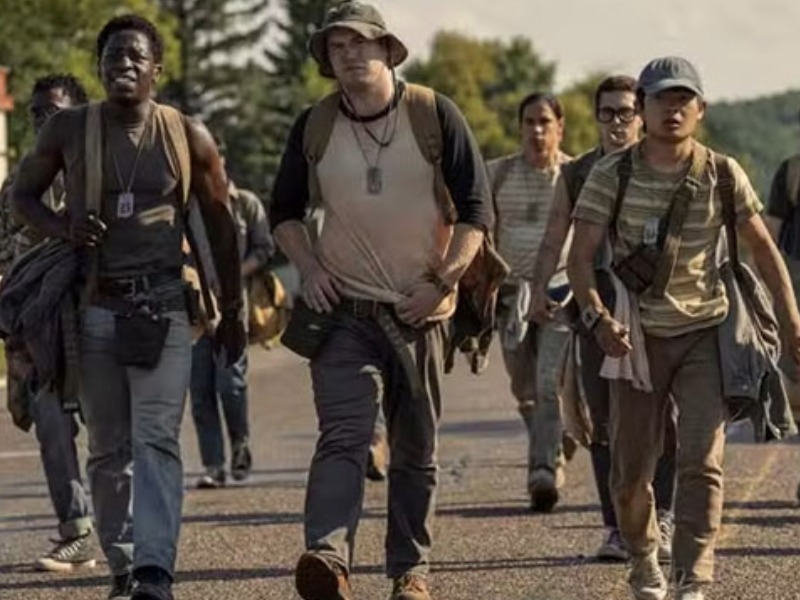
Walk or die. Three miles per hour. No stopping. Fifty boys enter. One leaves.
That’s the pitch for The Long Walk, Francis Lawrence’s adaptation of Stephen King’s bleakest novel—one King wrote at 19 while watching his generation get drafted into Vietnam, a story so dark he initially published it under a pseudonym. It’s a premise that sounds either brilliant or boring, depending on whether you think watching teenagers walk themselves to death for nearly two hours could possibly sustain narrative interest.
Here’s the truth: The Long Walk is one of the most emotionally devastating films of 2025, a relentlessly bleak meditation on fascism, friendship, and the American Dream’s fatal promise. It’s also divisive as hell—with an 88% critics score on Rotten Tomatoes but wildly split audience reactions ranging from “masterpiece” to “unwatchably dull.”
I fall firmly in the “masterpiece” camp, but I completely understand why some viewers walked out (pun intended). This is a film that asks you to sit with discomfort, to watch young men disintegrate physically and psychologically over the course of 350 miles, to find meaning in suffering that has no redemptive arc. If you need your dystopian thrillers with action set pieces and triumphant rebellion, this isn’t for you.
But if you want to feel something—really, truly feel something—The Long Walk will hollow you out and stay with you for days.
The Premise: American Nightmare as National Pastime
In an alternate 1970s America still reeling from “the war” (never specified, but the Vietnam parallels are impossible to ignore), the country hosts an annual event called The Long Walk. Fifty teenage boys, selected by lottery from each state, walk until only one remains alive. The rules are simple and brutal:
- Maintain a pace of at least 3 miles per hour
- Never stop walking
- Drop below the required speed, you get a warning
- Three warnings and you’re “removed” from the competition
- “Removed” means shot dead by the soldiers accompanying the walkers
The winner receives untold riches and any wish they desire, courtesy of the authoritarian government. The Major (Mark Hamill, in a chilling performance) oversees the spectacle, broadcasting it to a desperate populace who’ve been sold the lie that this violence will somehow restore the struggling economy and give them hope.
It’s The Hunger Games stripped of arena theatrics and world-building exposition. It’s a death march, broadcast as patriotic inspiration, sold as opportunity, functioning as population control and distraction from systemic collapse.
Raymond Garraty (Cooper Hoffman) enters the Walk to save his struggling mother from poverty. Peter McVries (David Jonsson) has his own reasons, ones we only partially glimpse. Over the course of their journey, these two form a bond that becomes the emotional anchor of the film—a friendship that might be the only authentic thing in a world built on lies.
What Works: Everything That Matters
Cooper Hoffman and David Jonsson Are Devastating
Cooper Hoffman and David Jonsson’s soulful performances bring a lot of heart to Stephen King’s dystopian tale, and that’s underselling it dramatically. These two actors carry the entire emotional weight of the film on their exhausted shoulders.
Hoffman (son of Philip Seymour Hoffman, and you can see flashes of his father’s intensity) plays Garraty with a combination of sensitivity and determination that makes you root for him even when “winning” means watching 49 other boys die. He’s the audience surrogate—uncomfortable with the violence, desperate to survive, forming attachments he knows are doomed.
Jonsson (brilliant in Foe and Industry) brings surprising warmth and optimism to McVries, a character who could have been one-note cynic but instead becomes the film’s beating heart. The chemistry between the entire cast is strong enough to create the brief illusion that these relationships could be sustained—which makes their inevitable endings all the more crushing.
The supporting cast—Ben Wang, Tut Nyuot, Charlie Plummer, Roman Griffin Davis—all create distinct, memorable characters despite limited screen time. You feel every death because these feel like real teenagers, not expendable extras.
Francis Lawrence Knows Exactly What He’s Doing
Lawrence directed three Hunger Games films, so he understands dystopian death games. But The Long Walk is very different to the likes of The Hunger Games, lacking in the glittery, flamboyant theatricality and extensive world-building characteristic of that franchise.
Instead, Lawrence opts for restraint and realism. It’s impressive that director Francis Lawrence shows a great deal of restraint in isolating the film’s events to the route itself. There are no flashy arena hazards, no elaborate costumes, no cutaways to control rooms or audience reactions. We stay on the road with the boys, experiencing their suffering in real time.
The cinematography by Jo Willems captures Dust Bowl-esque tableaus of twisted Americana, like a lone sad woman standing in front of a church, or empty storefronts along the main thoroughfare of an abandoned town. The landscape they walk through reflects the spiritual and economic desolation that created this nightmare in the first place.
The Violence Is Unflinching and Necessary
Fair warning: this film is graphically violent. The deaths themselves are brutal to the point of splattercore—skulls burst open with the force of bullets, legs are pulverized by tank treads—which punctuates how psychologically damaging it must be for the kids who witness it.
Some reviewers criticized this as excessive, but I’d argue it’s essential. King wrote this as a Vietnam allegory—about young men sent to die while America watched on television. The graphic violence isn’t exploitation; it’s honesty about what we’re watching. These aren’t video game deaths or sanitized PG-13 casualties. These are children being murdered by their government for entertainment.
Children cry out for their mothers, or beg for mercy, or worse, defiantly try to go out on their own terms. Every death feels like a gut punch because Lawrence refuses to let us look away or become numb to it.
The Themes Cut Deep
The Long Walk’s timely political and social commentary, about dystopian authoritarianism, violence as spectacle, and Orwellian censorship is plain to see. But what’s remarkable is how current it feels despite King writing it in 1967.
The film explores:
- Economic desperation as social control: These boys walk because their families are starving. The government offers wealth as bait while ensuring scarcity keeps people desperate.
- Violence as distraction: The spectacle keeps citizens focused on individual survival rather than systemic rot.
- The lie of meritocracy: “Anyone can make it if they try” coexists with the brutal truth that the system is designed for mass failure.
- Male friendship as rebellion: In a regime that demands competition and cruelty, forming genuine bonds becomes an act of resistance.
Director Francis Lawrence stated he sees the film as “a metaphor for the erosion of the American dream”, and that reading is impossible to ignore. These boys have been sold a promise—work hard, suffer nobly, and prosperity awaits—that the film systematically reveals as hollow.
The Ending Will Haunt You
Without spoiling specifics, the ending of The Long Walk has sparked significant debate. Some viewers found it cryptic and unsatisfying, similar to the book’s ambiguous ending. Others found it devastatingly perfect.
The film changes King’s original ending (with his blessing), and the alteration makes thematic sense even if it leaves some questions unanswered. What matters is that the darkness overwhelms. And the light—at least in the movie—cannot overcome it.
This is not a film that offers catharsis or hope. It’s nihilistic in the truest sense—it suggests that some systems are so rotten, some situations so hopeless, that individual heroism or friendship can’t overcome them. The Long Walk betrays its characters and destroys whatever meaning might’ve been gleaned from the journey.
Some will call that brave. Others will call it punishing. Both are correct.
What Doesn’t Work: The Pacing Problem
The film’s biggest weakness is also its defining characteristic: it’s slow. The film kind of flatlines early on and just keeps dragging its feet, literally. Nothing major really happens – it’s just endless walking with bits of dialogue sprinkled in.
For some viewers, this creates unbearable tedium. One IMDB reviewer complained: “Turns out, it’s just… walking. For almost two hours. Straight.” They’re not wrong—that’s literally what happens. Boys walk, talk, suffer, and die, in roughly that order, for 109 minutes.
The pacing mirrors the experience of the walkers themselves—monotonous, exhausting, endless. This is intentional, but intention doesn’t make it entertaining for everyone. If you need constant plot progression and dramatic escalation, the middle stretch will test your patience.
Instead of escalating, everything flattens, and by the halfway mark you can already predict how it’s going to end. The film doesn’t hide where it’s going. It’s not about the destination—it’s about forcing you to take every painful step alongside these boys.
Mark Hamill’s Performance Is… Divisive
Mark Hamill plays The Major, the overseer of the Walk who barks commands and promises over a loudspeaker throughout. It’s a performance so cartoonish as to be somewhat miscalibrated to the grimy sentiment of the picture; it’s the rare casting misstep found here.
Hamill leans into theatrical menace, delivering lines with the gravitas of a circus ringmaster announcing the next act. Some viewers found this effective—a reminder that this horror is being packaged as entertainment. Others found it jarring against the film’s otherwise grounded realism.
Personally, I think it works as deliberate contrast. The Major represents the system—performative, hollow, presenting cruelty as patriotism. His exaggerated delivery highlights the absurdity of the propaganda these boys have been sold.
Character Development Takes Shortcuts
With 50 contestants and limited runtime, most of the characters are forgettable or painfully stereotypical: the cocky one, the quiet one, the emotional one, the guy who clearly won’t make it past the halfway point.
The film focuses primarily on Garraty and McVries, with a handful of others getting brief moments to shine. But despite being offered little backstory for any of the contestants, the audience feels an unwavering attachment towards them—a testament to the actors more than the script.
Some deaths land with emotional weight. Others feel like numbers being reduced. It’s an unavoidable problem when your premise requires dozens of deaths but your runtime can only support developing a few characters deeply.
The Divided Audience: Why Some Love It and Others Hate It
With 88% critics approval but a “B” CinemaScore and wildly mixed user reviews, The Long Walk clearly isn’t for everyone. Here’s the split:
The “Masterpiece” Camp
Viewers who loved it praised:
- Devastating emotional impact and performances
- Unflinching honesty about violence and suffering
- Timely political commentary that feels urgent
- Francis Lawrence’s best directorial work
- One of the best King adaptations in years
SlashFilm called it “an emotionally obliterating all-time great Stephen King adaptation, and undoubtedly one of the best films of 2025”. High on Films declared it “a highly upsetting, shockingly cynical gem that’s worthy of sitting alongside classics like ‘The Shining,’ ‘The Dead Zone,’ ‘Christine,’ and ‘Misery'”.
One IMDB reviewer captured the power perfectly: “This movie cuts right to the heart of why any of us choose to get up each morning and walk around all day, even when life is throwing everything bad at us”.
The “Boring Slog” Camp
Viewers who hated it cited:
- Painfully slow pacing with no payoff
- Repetitive structure (walk, talk, die, repeat)
- Thin characterization and stereotypical archetypes
- Nihilistic ending that felt hollow rather than meaningful
- Too much graphic violence without enough substance
Guardian reviewer Steve Rose noted that the script left many blanks, writing: “It is left to the viewer to fill in the gaps, suppress their niggling questions and just go along with it”.
One frustrated viewer summed it up: “The tension fizzles, the characters are cardboard, and the emotional beats feel staged”.
The “Depends on What You Want” Middle Ground
The truth is that The Long Walk is exactly what it intends to be—a bleak, slow, emotionally punishing meditation on suffering, friendship, and systemic cruelty. Whether that sounds appealing or unbearable determines whether you’ll love or hate it.
Producer Roy Lee stated: “It made $65 million on a $20 million budget, so it didn’t lose money. It didn’t blow up, but I feel like it’s going to be similar to the way that The Shawshank Redemption is considered now. The Long Walk is, in a decade or so, going to be considered a classic”.
That might be wishful thinking, but it speaks to the film’s cult potential—the kind of movie that finds its audience slowly over years rather than exploding immediately.
Who Should Watch The Long Walk?
Watch The Long Walk if you:
- Want to be emotionally devastated (seriously, this wrecked me)
- Appreciate slow-burn, character-driven dystopian fiction
- Can handle graphic violence with thematic purpose
- Value performances over plot mechanics
- Don’t need redemption or hope in your storytelling
- Are fascinated by examinations of fascism and capitalism
- Love Stephen King’s darker, more literary work
- Want something that will stick with you for days
Skip it if you:
- Need constant action or plot progression
- Get bored by dialogue-heavy, slow-paced films
- Are sensitive to graphic violence and disturbing deaths
- Want uplifting or hopeful narratives
- Prefer clear explanations and world-building
- Can’t handle nihilistic endings
- Are looking for escapist entertainment
Content Warning: This film contains extremely graphic violence including exploding skulls, brutal deaths of teenagers, themes of authoritarianism, brief mentions of sexuality, and pervasive profanity. It’s deeply disturbing in ways that linger.
The Final Verdict: A Brutal Triumph
The Long Walk is not an easy watch. It’s not particularly fun. It won’t make you feel good about humanity or America or the future. What it will do is force you to confront uncomfortable truths about systems that chew up young people and spit them out, about how we package violence as virtue, and about the fragile, precious nature of human connection in hopeless circumstances.
Francis Lawrence has crafted something rare: a mainstream studio film that refuses to compromise its bleak vision or provide comfort. He trusts that the friendship between Garraty and McVries—genuine, tender, doomed—will carry us through the horror. And it does, right up until the film pulls the trigger one final time.
This is the leanest, meanest Stephen King adaptation in years, one that captures the author’s ability to find humanity in horror without softening the horror itself. Cooper Hoffman and David Jonsson deliver career-best performances that will be criminally under-recognized come awards season. And the film poses questions about American mythology that feel more urgent in 2026 than they did when King wrote them in 1967.
Will everyone love it? Absolutely not. Some will call the finale hard or brave or real. I call it nihilistic. But sometimes nihilism is the honest response to certain systems, certain horrors, certain truths we’d rather not face.
The Long Walk doesn’t offer false hope or cathartic release. It offers something rarer: brutal honesty about suffering, and a reminder that even in hell, friendship matters. Even when it can’t save you.
What works: Devastating performances from Hoffman and Jonsson, unflinching direction from Lawrence, graphic but meaningful violence, timely political commentary, refusal to provide false comfort, genuine emotional impact
What doesn’t work: Slow pacing will bore some viewers, Mark Hamill’s performance divides opinion, thin characterization for supporting cast, nihilistic ending won’t satisfy everyone
Bottom line: One of 2025’s best films and best King adaptations, but only if you’re prepared for emotional devastation. This isn’t entertainment—it’s endurance. And like the walkers themselves, you’ll emerge changed by the experience.
Rating: 5/5
You can watch on:
- Amazon
- Starz