A flawed but genuinely unsettling supernatural horror that buries something fresh and mythologically rich beneath layers of familiar genre furniture. Worth watching for its performances and atmosphere — just don’t expect all the mysteries to resolve neatly.
The Setup
Will Canon returns to feature filmmaking a full decade after his FrightFest-favourite Demonic (2015), and the fingerprints of that earlier work are very much present in The Confession. The film opens with Arthur Riley (Craig Kolkebeck), a small-town preacher dressed in his clerical collar, pushing a wheelbarrow of Holy Bibles into a Texas lake — and then calmly walking in after them. It is a quietly devastating image, a death steeped in deliberate ambiguity, and it sets the tone for everything that follows.
His daughter Naomi (Italia Ricci), a once-promising rock musician whose career has stalled into dive-bar gigs, moves back to the family homestead in the fictional Texas town of Elbe with her young son Dylan (Zachary Golinger) following both her father’s death and the loss of her husband. She hopes to grieve, to reconnect, to write new music. What she finds instead is a cassette tape — her father’s voice confessing to the murder of a local troublemaker named Royce Cobb, a killing he claims to have committed to protect his family from a dark and ancient force. Before long, Dylan is behaving in ways that are deeply disturbing, the townsfolk are cold and unwelcoming, and the secrets buried beneath Elbe’s soil begin to surface.
The Pied Piper Twist
What genuinely separates The Confession from the crowded field of “grieving mother moves into haunted house” horror is its decision to anchor its mythology in the legend of the Pied Piper of Hamelin. Canon doesn’t simply retell the fairy tale — he transplants its DNA onto a Texan landscape, weaving in rats, music, missing children, and a community’s collective guilt into a meditation on inherited sin. The town of Elbe — pointedly named, as it is a place of exile — is haunted not just by a ghost but by what its founders once bartered away.
This choice gives the film a genuine thematic richness that elevates it above a standard genre exercise. The question the film keeps circling is not simply what is this evil? but why does evil keep returning to the same families? Naomi’s late father was a preacher, a man of God, yet he committed murder. Naomi herself has abandoned her faith. Dylan — innocent, bewildered, and frightened — is the next in a generational line targeted by something that the town made a deal with long ago. Canon frames this as an American story: a nation founded on buried injustices, forever haunted by debts deferred to its children.
Performances
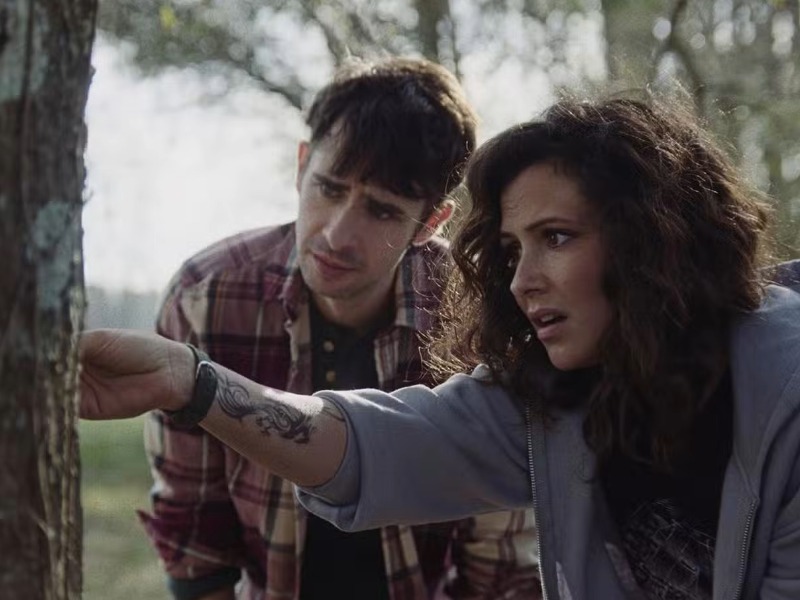
Italia Ricci anchors the film with a grounded, emotionally credible performance. Her Naomi is not a passive scream queen but a woman genuinely grappling with grief, guilt, failed faith, and maternal terror simultaneously — a combination that could easily tip into melodrama but rarely does. She holds the film together in its wobblier second act through sheer conviction. Zachary Golinger as Dylan is the film’s other standout: he conveys the specific horror of a child who is frightened of himself, navigating innocence and menace with a natural fluency that is genuinely chilling. Scott Mechlowicz, as Naomi’s childhood friend Grayson — now an investigative journalist — provides capable support, and Canon makes smart choices with supporting characters who subvert expectation rather than fulfilling genre stereotypes.
Direction and Atmosphere
Visually, The Confession opts for a muted, naturalistic palette that gives the film the quality of an unearthed artefact — something old and faded, as if the story itself has been buried in a box in an attic. The cinematography draws deliberate comparisons to films like The Haunting in Connecticut, using shadows, cramped domestic spaces, and oppressive quiet more than jump scares. The scare sequences are, for the most part, well-handled; a handful land with genuine chill, particularly those centring on Dylan’s transformation. The sound design is subtle but effective, using silence and low frequency as much as conventional horror stings.
The pacing, however, is uneven. The first act establishes mood and character with confidence. The second act — which involves Naomi essentially solving a series of cryptic clues left by her father — begins to feel, as one perceptive reviewer noted, uncomfortably like navigating an escape room. There are too many dangling threads and the film’s mythology, ambitious as it is, does not always cohere under scrutiny.
Where It Stumbles
Canon’s script is where the film most noticeably strains. Certain narrative elements — the significance of a name found on buried bones, a shifting timeline, the mechanics of the evil force itself — are either underdeveloped or obfuscated to the point of frustration rather than productive ambiguity. The film’s religious themes, while thematically interesting, are at times heavy-handed, and a subplot involving Christian ritual and baptism in the third act will divide audiences sharply between those who find it spiritually resonant and those who find it preachy. The presence of rats — a clear nod to the Pied Piper — feels decorative rather than purposeful in several scenes, hinting at a mythological framework that the script never fully exploits.
The film also carries the weight of its influences too visibly on its sleeve. Canon has cited cinematic antecedents ranging from Smile and The Boogeyman to Neil Jordan’s In Dreams and the template of a submerged ghost town, and viewers familiar with these works will feel a persistent, low-level sense of déjà vu. The Confession is fresher than most of its genre contemporaries in conception, but conventional in execution.
The Ending
Opinions on the film’s final act are polarised. For some, it delivers a chilling, unexpected reversal that recontextualises much of what has come before — a genuine payoff for those willing to follow the film’s winding road. For others, it represents the moment the film collapses under the weight of its own ambition, leaving too many threads unresolved. The ending is, at minimum, bold — a quality that feels increasingly rare in mainstream supernatural horror.
What works
- Ricci and Golinger deliver genuinely strong central performances
- Pied Piper mythology is a fresh and resonant conceptual frame
- Atmosphere, cinematography, and sound design are consistently strong
- Thematic depth around generational sin and inherited darkness
- Surprising, subversive character choices throughout
- An ending that is bold and genuinely unexpected
What doesn’t
- Second act pacing loses momentum in a maze of cryptic clues
- Mythology is underdeveloped and inconsistent under pressure
- Religious themes tip into heavy-handedness at times
- Rat symbolism feels decorative rather than purposeful
- Genre influences are worn conspicuously; déjà vu is persistent
- Narrative threads left frustratingly unresolved
Final Verdict
The Confession is an imperfect but worthwhile supernatural horror — ambitious in concept, uneven in execution, and elevated above its genre contemporaries by two committed central performances and a mythology that deserves a sharper script. Recommended for patient fans of atmosphere-driven, character-grounded horror.
It’s the kind of horror film that will reward patient viewers who appreciate mood and theme over pure scares, and frustrate those who want clean mythology and tight plotting. A solid 6.5/10 — flawed, but worth your time if supernatural family horror is your genre.
Rating: 2/5