There is something almost poetic — and painfully fitting — about the fact that Return to Silent Hill took two decades to arrive. French director Christophe Gans first brought the iconic Konami survival horror franchise to cinemas in 2006 with Silent Hill, a visually audacious and genuinely unsettling adaptation that, while not universally praised, earned a devoted cult following and stood out as one of the better video game movies of its era. Plans for Gans to adapt Silent Hill 2 — widely considered the gold standard of psychological horror in gaming — were announced almost immediately after that film’s release, only for the project to collapse and eventually be handed off to a different team for the widely reviled Silent Hill: Revelation in 2012.
Now, finally, Gans gets his second chance. Return to Silent Hill is the third film in the franchise and a reboot, loosely based on the 2001 video game Silent Hill 2 by Konami. The anticipation among fans was enormous. Silent Hill 2 is not just a beloved horror game — it is a work of genuine psychological depth, exploring grief, guilt, sexual repression, and the human capacity for self-deception through symbolism and subtext that rivals serious literary fiction. The 2024 remake of the game had just reminded an entire new generation why the story remains so powerful. So the question going into Gans’ long-awaited adaptation was never really whether it would be scary. The question was whether it would be worthy.
After sitting through Return to Silent Hill, the answer, unfortunately, is mostly no. And that is a deeply frustrating conclusion to reach, because the film is not a disaster. It is something arguably worse: a missed opportunity of the highest order.
THE STORY: LOVE, LOSS, AND A LETTER FROM THE DEAD
The film follows James Sunderland, a broken man who receives a mysterious letter which calls him back to Silent Hill in search of his lost love. The film opens with a meet-cute: James, a troubled painter searching for scenic inspiration, nearly causes a car accident involving Mary Crane, a beautiful young woman who happens to be leaving her hometown of Silent Hill. She misses her bus because of him, he offers her a ride, and what follows is a tender, blossoming romance that eventually leads them both to settle in the fog-drenched town.
Years later, that romance is long over. Mary has died from a terminal illness, and James has descended into alcoholism and mental instability, under the reluctant supervision of a concerned psychologist. Then the impossible happens: James receives a letter written in Mary’s hand, urging him to return to Silent Hill. Abandoning all caution and common sense, he goes.
What he finds when he arrives is a town consumed by ash and fog, largely abandoned, decaying from the inside out. Something has happened to Silent Hill — something dark and supernatural — and as James wanders its empty streets searching for any trace of Mary, he is hunted by grotesque monsters, crosses paths with a handful of deeply troubled strangers, and begins to question whether the town is punishing him for something he cannot fully bring himself to remember.
This is, on paper, a devastatingly rich premise. The original Silent Hill 2 game used exactly this framework to construct one of the most emotionally harrowing stories in the horror genre — a man consumed by guilt navigating a world that has literally manifested his inner demons. Director Christophe Gans understands Silent Hill so arrestingly and vividly when it comes to visual nightmare fuel that it makes it all the more frustrating that he still doesn’t fully grasp what he is adapting, not only from a place of psychology, but in the case of Return to Silent Hill, the story itself.
DIRECTION AND ATMOSPHERE: WHERE THE FILM SHINES
Let it be said clearly: when Return to Silent Hill works, it genuinely works. Gans has always been a director with a strong visual instinct, and he brings that eye fully to bear here. The town of Silent Hill is rendered with real craft — its abandoned streets coated in grey ash, its buildings crumbling under the weight of something unseen, its air thick with fog that blurs the line between the real and the unreal. Pablo Rosso’s camerawork is frequently inspired, framing Silent Hill in stark, oppressive compositions that emphasise its scale and emptiness. The sound design is similarly ominous, dominated by industrial drones and low, unearthly groans suggesting an ever-present menace.
The film also makes excellent use of what it calls the Otherworld — the nightmarish alternate version of the town that erupts into existence whenever James hears the wail of a siren, transforming the grey ashen streets into a hellscape of rusted metal, fire, and rot. These sequences are the film’s most visually striking, and Gans handles the transitions between the two realities with genuine skill, using the Otherworld as a pressure valve that ratchets up tension whenever the film threatens to become too static.
With a knack for trippy editing that strings James along from one location to another, Return to Silent Hill is still downright terrifying at times. Several sequences — particularly involving the film’s creature designs — land with real impact. The monsters here are genuinely disturbing: armless, twitching figures who move like uncanny marionettes, swarms of cockroach-like creatures, and a rotating cast of grotesques that speak to some deep primal discomfort. Creature designer Patrick Tatopoulos deserves significant credit for bringing these beings to life in ways that feel tactile and threatening, particularly in scenes relying on practical effects.
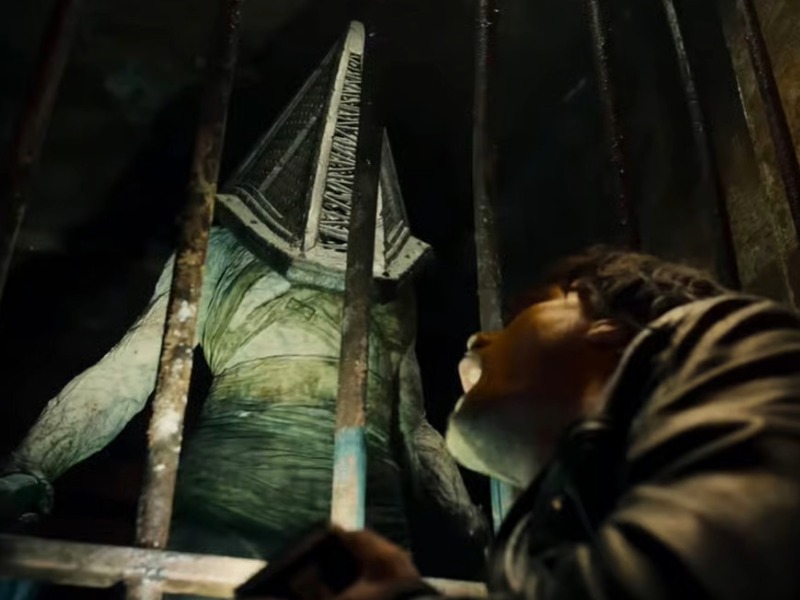
And then there is Pyramid Head. The franchise’s most iconic figure, the towering, blade-dragging juggernaut with a metallic red pyramid for a head, returns here played by Robert Strange, and his appearances are genuinely imposing. In the original game, Pyramid Head functions as a manifestation of James’s guilt — a punishment he subconsciously summons upon himself. The iconic monster design is used sparingly and symbolically, reinforcing its role as a manifestation of internal punishment rather than a conventional antagonist. That restraint is admirable. The problem is that the film does not give this symbolism enough narrative grounding for the symbolism to land with full force.
THE SCORE: AKIRA YAMAOKA DELIVERS
One element of Return to Silent Hill that is difficult to fault is its music. Akira Yamaoka, who has scored the vast majority of the Silent Hill game series, composed the music, and music from the original game was used as temp music during editing. In a January 2026 interview, Gans said he would have refused to make the film without Yamaoka’s involvement. That commitment shows. Yamaoka’s score is mournful, industrial, and deeply unsettling in all the ways fans of the games will immediately recognize — layers of distorted guitar, eerie ambient textures, and melancholic melodies that carry an emotional weight the screenplay itself often fails to earn. Across multiple characters, developers, publishers, and mediums, Yamaoka remains one of the more consistent elements of the franchise, and completionists will have another album to add to their collection.
There is a cruel irony in the fact that Yamaoka’s score frequently suggests a deeper, more emotionally coherent film than the one actually playing on screen. His music reaches for the grief and guilt at the heart of the story with far more precision than the screenplay manages. More than once, a scene lands with unexpected emotional impact almost entirely because of what is playing on the soundtrack.
THE PERFORMANCES: DOING MORE WITH LESS
The cast of Return to Silent Hill is working hard against significant limitations, and several of them manage to carve out genuinely memorable moments despite the screenplay’s shortcomings.
Jeremy Irvine leads the film as James Sunderland. He nicely captures the grief and underlying guilt of his character, playing a slightly more manic version of James than game fans may be accustomed to. Irvine is a physically committed performer, and he brings a raw, disheveled desperation to the role that suits the material. He ably conveys confusion and determination, reacting believably to the strange and unsettling world around him. However, there is little for him to do beyond that, as the character is written thinly and left stranded by the film’s incoherent narrative. The screenplay never gives James a properly written inner life — we are told he carries guilt and grief, but we are rarely allowed to feel it alongside him in the way the game made players feel it so devastatingly.
Hannah Emily Anderson faces perhaps the film’s most demanding challenge, playing multiple roles: Mary, the lost love whose death haunts James; Maria, a mysterious doppelganger who seems to represent something darker about his desires; and Angela, another lost soul who has her own reasons for being drawn to Silent Hill. Anderson is brilliant in playing the polar opposite Mary and Maria personas. Her work as Mary in particular — warm, luminous, tinged with sadness — gives the film some of its most genuinely affecting moments. It is a shame the screenplay does not give her more room to develop Angela, who in the game is one of the most heartbreaking characters in the franchise’s history and is here reduced to a minor supporting role with almost no payoff.
Young Evie Templeton makes an impression as Laura, the young girl who seems to know more about Mary than she should. Templeton is suitably creepy as Laura, and her presence adds an unsettling quality to several scenes. The rest of the supporting cast — including Pearse Egan as the troubled Eddie — are largely wasted. All of these characters are missing key scenes and have zero resolution to their plot arcs, even though their stories are intended to thematically intersect with James’s personal journey into hell.
THE SCREENPLAY: WHERE IT ALL FALLS APART
If the film has a fatal flaw, it is the screenplay, and it is a fatal flaw in the most literal sense — it undermines everything else the film attempts to do. The narrative does not make much sense. If one is unfamiliar with the video game it is based on, one is left completely out in the cold. And even for fans of the game, the changes made to the story range from puzzling to genuinely baffling.
Much of Return to Silent Hill involves James running from one scary situation to the next, with no plan or sense of progress whatsoever. The whole movie exists less to tell a coherent story than as an excuse to explore creepy imagery. The film is structured as a series of increasingly desperate encounters — James arrives in a building, something horrible happens, James escapes, James arrives in another building — without the connective tissue that would give these scenes cumulative weight. There is no sense of James getting closer to anything, no building revelation, no tightening grip of dread. The film just lurches forward until it ends.
The decision to open the film with a romantic flashback — showing how James and Mary first met — is well-intentioned but misguided. In the game, the opening is one of the most powerful in horror history: James alone in a bathroom, staring at himself in a cracked mirror, muttering quietly about the letter he has received, his voice already fractured with something he cannot name. It immediately plunges the player into James’s damaged psychology. The movie’s approach actively undermines the plot, as it’s shown that Mary’s familial ties to a cult not only had a hand in her eventual demise, but even resulted in her and James breaking up for most of her illness. This changes the emotional geometry of the entire story in ways that make its eventual revelations land with far less impact.
The supporting characters suffer most from the screenplay’s failures. Laura, Eddie, and Angela all have their own dramatic backstories that led to their arrivals in town, which subsequently forces them to confront both the conscious and subconscious traumas in terrifying forms — but the film never commits to exploring any of these arcs. They appear, say a few lines, and vanish. For fans of the game who know just how much these characters were meant to mean, their handling here is genuinely disheartening.
THE VISUALS: BEAUTIFUL AND BROKEN
The production design by Jovana Mihajlovic deserves genuine praise. Gans and Mihajlovic replicate images and whole scenes from the game and its 2024 remake — costumes, set pieces, monsters, and even specific environmental details look identical to the game. For fans, there is real pleasure in seeing these images realized at feature-film scale, rendered with care and obvious love for the source material. The physical sets in particular — the crumbling apartment buildings, the decayed hospital corridors, the fog-blanketed streets — have a tangible, oppressive quality that CGI-heavy productions often lack.
However, the film’s visual effects are inconsistent in ways that occasionally shatter the illusion. The realities of production mean that the film feels quite cheap in places, and while special effects continue to advance, budget constraints leave some scenery looking wobbly. Several creature sequences that should be terrifying are undercut by digital effects that look unfinished, pulling the viewer out of the nightmare at precisely the moments when full immersion is most needed. The movie ends up looking like a feature-length cutscene rendered with embarrassing digital effects in its weakest moments — a comparison that stings particularly hard given that the 2024 game remake it draws from looked extraordinary.
THE ADAPTATION QUESTION: FAITHFUL TO THE WRONG THINGS
The most pointed criticism of Return to Silent Hill — and the one that will matter most to the audience most likely to seek it out — is that it is faithful to the surface of Silent Hill 2 while being largely indifferent to its soul.
The game is, at its core, a story about what people do to escape unbearable guilt. It uses every tool at its disposal — level design, sound, monster symbolism, character interaction — to create a portrait of a man so unable to confront his own actions that he has built an entire psychological reality to protect himself from the truth. The monsters are not random. They are not simply scary. They mean something. Pyramid Head means something. The nurses mean something. The fog and the darkness mean something. Those passionate about the source material will most likely be disappointed. Meanwhile, newcomers will almost certainly see some unrealized potential, or at least something that hints at why the game is still heralded in some circles as the peak of psychological horror.
Gans clearly loves this material. His visual choices demonstrate a deep familiarity with the game’s iconography. But loving the images of something and understanding its meaning are different things, and Return to Silent Hill too often mistakes the former for the latter. The film feels like a series of jumbled Silent Hill cutscenes that do not all stitch together — a pointlessly gruesome fever dream with a hard-to-pinpoint plot.
THE VERDICT: LOST IN THE FOG
Return to Silent Hill is not without merit. It is atmospherically accomplished, features some genuinely terrifying creature sequences, boasts a brilliant score from Akira Yamaoka, and contains committed performances from a cast that deserved better material. As a pure sensory experience — as a collection of disturbing images set to haunting music in a beautifully decayed world — it has its moments.
But horror has never worked on sensation alone, and Silent Hill 2 in particular has always been about something far deeper than atmosphere. It is a story about guilt, trauma, and the unbearable weight of what we do to the people we love. That story needed a screenplay that matched its ambition, characters given the room to breathe and break and mean something, and a director willing to spend as much time in the psychology of its protagonist as in the visual horror of the world around him. Return to Silent Hill gives us the fog without the grief, the monsters without the symbolism, and the town without the soul.
A visually restless sequel that lumbers along with a plodding pulse and lacking the thematic resonance that distinguished its source material, Return to Silent Hill gets lost in the haze. It is a film that will satisfy almost no one completely — too confusing for newcomers, too shallow for devoted fans, and too unfocused to work as a straightforward horror film for casual audiences. It is a film made by someone who clearly cares about Silent Hill, which makes its failures all the more painful.
Twenty years of waiting for this. The fog has lifted. And the town, this time, is empty.
Rated R for violence, gore, language, and disturbing imagery. Now streaming.