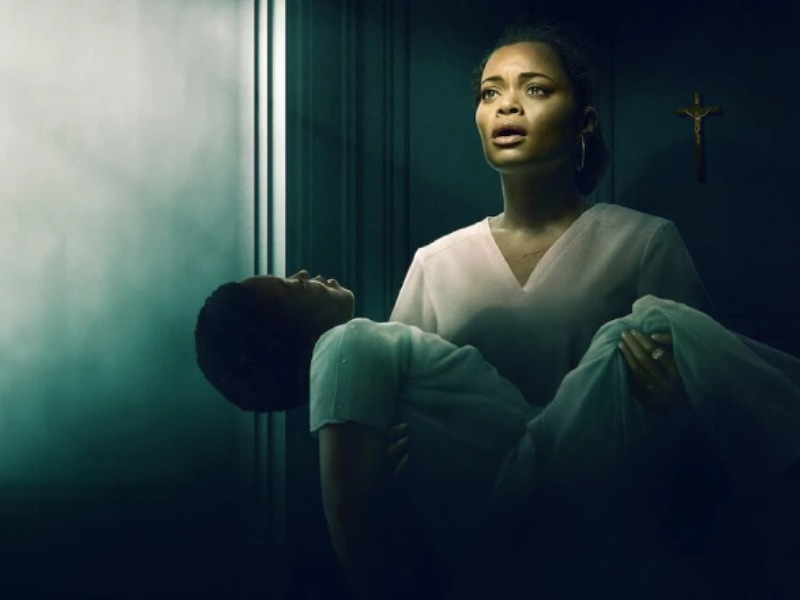
When Netflix announced a horror film directed by Lee Daniels — the acclaimed filmmaker behind Precious, The Butler, and Empire — featuring an all-star cast led by Oscar nominee Andra Day and the legendary Glenn Close, expectations were understandably high. Add to that the tantalizing premise of a true-life demonic haunting, and The Deliverance had all the ingredients for a genre-defining hit. The result, however, is a film that is simultaneously better than you might expect and more frustrating than it should be — a movie that contains flashes of genuine brilliance buried beneath the weight of familiar horror conventions.
The Deliverance is bold, emotionally raw, and anchored by performances that are nothing short of extraordinary. It is also uneven, overlong, and ultimately undermined by a final act that abandons everything that made it compelling in the first place. It is a tale of two films: one a gritty and moving family drama, the other a by-the-numbers supernatural thriller. Whether those two halves add up to something worth watching depends entirely on what you bring to it.
THE TRUE STORY BEHIND THE FILM
Before diving into the film itself, it is worth understanding where it comes from, because the real story is as remarkable as anything Hollywood could invent.
The Deliverance is directly inspired by the Ammons family haunting, a case of alleged demonic possession that occurred in 2011 in Gary, Indiana. The real-life story centers around Latoya Ammons, her mother Rosa Campbell, and her three children.
Director Lee Daniels took inspiration from a 2014 Indianapolis Star article titled “The Exorcisms of Latoya Ammons,” written by journalist Marisa Kwiatkowski, which chronicled the experiences of the Ammons family, who claimed they were haunted by a demonic presence and swarms of unkillable black flies after moving into a rental house in Gary, Indiana in 2011. Their home would become known as the “Demon House.”
Over the course of several months, the family — and multiple witnesses, including law enforcement officers — reported the children levitating, the children’s behavior and appearance changing, and children speaking to invisible people in the house. By the spring of 2012, child services had taken the children into protective custody. The case eventually led to a series of exorcisms performed across multiple churches. The Ammons haunting has left an indelible mark on popular culture, particularly in horror, and has since become one of the most famous cases of modern-day alleged demonic possession in the United States.
Director Daniels said he did his best to “distance the film from the true story” by changing the character names and setting the story in Pittsburgh rather than Gary. He also changed the lead character’s name from Latoya to Ebony. Andra Day confirmed she did not speak to Ammons to prepare for the role. “Lee was specific in the beginning that he did not want me to. He wanted this character to have her own layers. He wanted her to be her own person,” Day explained.
Daniels himself had a complex relationship with the source material. “Because this was based on a true story, there was some hesitation on my end around touching it. So I let it sit for a while,” Daniels said. But the filmmaker ultimately found his way into the story when he realized it was about faith as much as it was about fear. “In the story, LaToya Ammons finds Jesus,” he said. “And I felt, with everything going on in the world, we all needed that. We all need to find a higher power.”
Daniels has also claimed that strange occurrences happened on set during filming, including sudden illnesses and the death of his dog.
PLOT SUMMARY
Looking for a much-needed fresh start, a struggling single mother named Ebony Jackson, played by Andra Day, moves her three children to a new house in Pittsburgh. She is accompanied by her deeply religious mother Alberta, played by Glenn Close, and is already fighting a losing battle with alcoholism, financial instability, and the ever-present threat of losing custody of her children to social services.
From the moment the family arrives at the new home, something feels off. The children begin exhibiting strange behavior. Ebony is an alcoholic who secretly pays her mother’s medical bills, and clashes with family members and authority figures while trying to retain custody of her children. These very human tensions — the fractured mother-daughter relationship, the simmering resentment from the older kids, the vulnerability of the youngest — form the emotional backbone of the film’s first half.
As the story progresses, the supernatural elements slowly creep in. Anthony B. Jenkins plays Andre, Ebony’s youngest son, whose innocence is tested by the supernatural occurrences enveloping his family. Caleb McLaughlin portrays Nate, the eldest son, whose resentment and fear simmer beneath his interactions with his family and the lurking dangers.
It all culminates in a trope-riddled final act that goes full Exorcist mode. Ebony faces demonic voices, body contortions, levitations, and even a stigmata as her motherly instincts kick in and she fights for the souls of her children.
The film’s final moments give a subtle but unnerving hint that the demonic threat might still be lingering. As the family leaves the haunted house, viewers are shown lingering shots of the house and reports of unexplained things happening in the vicinity, implying that the evil might not have been defeated completely.
DIRECTION: LEE DANIELS AT THE HELM
Inspired by a true story, The Deliverance is directed by Academy Award nominee Lee Daniels and offers a genre-defying take on darkness, possession, and finding a higher power. Daniels is a filmmaker with an unmistakable voice — raw, emotionally unguarded, and unafraid of difficult subject matter. That voice is fully present in the film’s first half, which is among the most authentic and gripping family drama sequences he has put on screen since Precious.
“I didn’t see it as a horror film, at least not in the way people have come to expect,” Daniels told Netflix. That sentiment is both the film’s greatest strength and its central problem. Daniels is clearly more comfortable, and more skilled, in the territory of human drama than genre horror. When he leans into the former, the film soars. When the demands of the horror genre take over, something is lost.
Netflix is said to have paid a hefty $65 million to get the rights to the movie, which is part of Netflix’s “mid-budget” film lineup. The money shows in the production design, the period setting, and the assembled cast. But no budget can substitute for a screenplay that successfully bridges two very different tonal registers.
THE CAST: WHERE THE FILM TRULY SHINES
If there is one area where The Deliverance is beyond reproach, it is the performances. This is a cast operating at the very top of their game, even when the material fails them.
Andra Day as Ebony Jackson is the emotional center of the film, and she carries it with extraordinary conviction. Day’s portrayal is raw and compelling, presenting a character whose depth and complication are the heart of the film. Ebony is not a straightforward sympathetic protagonist — she is flawed, volatile, and at times deeply difficult to root for. Day never flinches from any of it. Her physical and emotional commitment to the role is total. This is Day’s second major venture in film after her leading role as legendary four-time Grammy winner Billie Holiday in the 2021 movie The United States vs. Billie Holiday, for which she received an Academy Award nomination. With this performance, she further cements her status as one of the most compelling screen presences of her generation.
Glenn Close as Alberta is nothing short of scene-stealing. Close’s Alberta is both a source of conflict and comic relief. She’s going through her recovery from cancer with a fiery spirit that clashes with the darker tones of the film. The dynamic between Ebony and Alberta — two women bound by love and bruised by years of unresolved hurt — gives the film its most authentic and affecting moments. Glenn Close certainly delivers a powerful performance, as does everyone in the cast. Close, famously nominated for an Academy Award eight times without a win, gives the kind of fearless, transformative performance that should silence any doubters.
Mo’Nique, Aunjanue Ellis-Taylor, Omar Epps, and Caleb McLaughlin round out an ensemble that is uniformly strong. Daniels has assembled a strong and committed cast who bring their A game to the material. Even in scenes where the writing lets them down, the actors find truth and depth. It is a testament to the quality of the ensemble that the film remains watchable throughout, even when the script loses its footing.
THE FIRST HALF: FAMILY DRAMA THAT GRIPS
It is worth spending time on what The Deliverance gets right, because it gets quite a lot right — particularly in its opening hour.
The film flourishes as a family drama in its first half, exploring the complicated web of love, resentment, addiction, poverty, and trauma that binds the Jackson family together. The tension between Ebony and Alberta is rendered with honesty and nuance. Ebony’s struggles with alcoholism and her fraught relationship with her children feel grounded and real. The family drama is good, filled with tension and depth, and the film’s themes are thought-provoking.
The racial and social undertones of the film also add meaningful layers. A Black single mother fighting social services, battling addiction, and trying to hold her family together against impossible odds — these are themes that Daniels handles with the sensitivity and specificity that has always distinguished his best work. The film doesn’t shy away from how systemic forces complicate Ebony’s situation, and those elements elevate it well above the average haunted house story.
THE SECOND HALF: WHERE THE WHEELS COME OFF
And then the horror arrives — and with it, a significant drop in quality.
The film waits far too long for the horror elements, which end up looking like an abrupt afterthought. When the supernatural sequences finally take center stage, they feel like they belong to a different, lesser movie. What starts out as a sincere dysfunctional family drama turns into a hokey supernatural horror thriller that erodes any chance of taking it seriously.
There seems to be some admirable allegorical intent. Sadly it’s all but lost as the movie turns into a generic copy-and-paste possession flick. The final 30 minutes end up clashing with nearly everything that came before it, wasting a fierce performance from Andra Day along the way.
The CGI, in particular, is a significant weak point. The eventual deliverance is on par with what movies try to be when using demons as background — too fantastical and action-driven, focusing on being scary with the wrong props. One of those props being CGI, which is quite bad for 2024.
The runtime of 1 hour and 52 minutes is a tad too long. Tighter editing — particularly in the transition from the family drama to the horror sequences — would have greatly improved the film’s overall cohesion and pacing.
THEMES: FAITH, REDEMPTION, AND FAMILY
Beneath the jump scares and demon effects, The Deliverance is trying to say something meaningful about faith and redemption. Daniels set out to put his own stamp on a classic exorcism story, infusing it with the spirituality of the Black church. That ambition is admirable, and in the film’s quieter moments — particularly those involving Alberta’s faith and Ebony’s gradual spiritual awakening — it pays off beautifully.
The film is, at its core, about a woman who must confront her own darkness before she can confront the darkness threatening her family. Ebony’s arc from denial to reckoning to redemption is genuinely moving, and Andra Day ensures that journey feels earned. The tragedy is that this thematic richness is ultimately overwhelmed by the generic demands of the possession horror genre.
The Ammons haunting case has influenced discussions around the intersection of faith, mental health, and the supernatural, and the film gestures toward all of these themes — but doesn’t fully commit to exploring any of them with the depth they deserve.
HOW IT COMPARES TO OTHER POSSESSION FILMS
The Deliverance invites obvious comparisons to The Exorcist, The Conjuring, and The Exorcism of Emily Rose, and it is a comparison the film mostly does not survive. The actual execution is a very standard reworking of tropes we’ve seen time and time again that have long since worn out their welcome.
Where films like The Conjuring series succeed is in building genuine dread through atmosphere and restraint. The Deliverance abandons restraint almost entirely in its final act, opting instead for spectacle. The result is loud, frantic, and largely ineffective as horror. What could have been a genuinely terrifying and culturally specific entry in the possession genre instead settles for being a technically accomplished but ultimately generic example of it.
FINAL VERDICT
The Deliverance is a film that will frustrate as much as it impresses. It boasts a remarkable ensemble of actors giving everything they have, a director with a clear and powerful vision for its human story, and a true-life premise that is inherently compelling. For long stretches, it is genuinely gripping.
But it is also a film undone by an identity crisis — unable to fully commit to being either the devastating family drama it begins as or the scary horror movie it becomes. The two halves never fully merge, and the seams show badly in the final act.
The cast — Close, Day, and Mo’Nique — deserve better material in the final act. And yet, paradoxically, their performances are reason enough to watch. If you can appreciate a deeply human drama set against a supernatural backdrop, and if you can forgive a clunky, overly familiar conclusion, there is much to admire here.
This is not the definitive Black horror film it could have been. But it is a film with genuine heart, exceptional performances, and moments of real power — a flawed but memorable effort from a filmmaker who swings for something more than the ordinary, even if he doesn’t quite clear the fence.