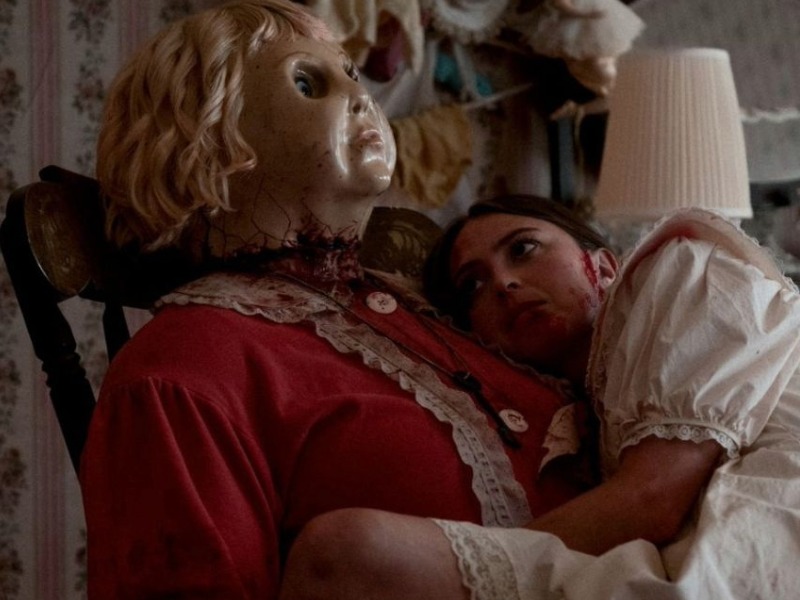
There’s a specific kind of dread that only backwoods horror can conjure — the sense that civilization ends where the tree line begins, and something feral is waiting on the other side of it. Dolly leans hard into that dread, and for long stretches, it works.
The setup is classic slasher bait: Macy (Fabianne Therese) and her boyfriend Chase (Seann William Scott) head into a remote stretch of the East Tennessee mountains for a hike, with Chase secretly planning to propose. The romance doesn’t survive the first act. Separated from Macy, Chase stumbles onto a massive, porcelain-doll-masked figure burying a headless corpse and mourning over it like a child who’s lost a pet. What follows is a shovel to the leg, a mutilated jaw, and a man left for dead in the dirt. Macy, searching for him, gets run down and dragged into the nightmare proper.
She wakes up in a nursery. A literal, oversized crib. Another captive man in the next room over tells her to play along with their captor’s “game” — find the key, or else. The masked woman, credited only as Dolly, wants a baby. She’s decided Macy will be it, and she’s prepared to break her down, piece by piece, until she accepts the role.
What Works
Let’s start with Max the Impaler, the film’s genuinely unsettling silent villain. There’s no dialogue, no unmasking monologue, no cute one-liners — just a hulking, wordless presence whose “mothering” instincts curdle into something far more disturbing than a typical machete-wielding maniac. The doll mask itself is a great piece of design: blank, glassy-eyed, and just human enough to be deeply wrong. When it eventually cracks to reveal the scarred face underneath, the reveal earns its shock without over-explaining the backstory.
The film’s centerpiece sequence — Macy discovering a doll in the basement with a real human head grafted onto it, dangling the key she needs — is the kind of image that horror fans will be describing to friends for years. It’s grotesque, it’s a little bit funny in its audacity, and it tells you everything you need to know about what’s happened to previous “children” in this house without a word of exposition.
Shot on 16mm, the movie has a genuinely tactile, grimy texture that recalls ’70s exploitation cinema — the kind of grainy, sun-bleached look that digital horror rarely bothers to chase anymore. When Dolly commits to that aesthetic, it’s a nasty, effective throwback. Fabianne Therese also deserves credit for carrying most of the back half essentially solo, selling both the physical toll of captivity and the specific psychological ugliness of forced, humiliating roleplay without tipping into camp.
What Doesn’t
Here’s the problem: Dolly keeps undercutting its own atmosphere. That painstakingly built grindhouse texture gets interrupted by slick drone shots that no 1970s exploitation film could have ever pulled off — a small choice, but one that breaks the spell every time it happens. It’s a movie that wants you to believe you’re watching something unearthed from a drive-in decades ago, and then reminds you, again and again, that you’re not.
The plotting has similar issues. Once Macy discovers her fellow captive is actually Dolly’s father, playing his own angle to escape, the film’s momentum stumbles into a string of contrivances — hostage swaps, a suspiciously well-timed park ranger, a getaway that resolves a little too cleanly. None of it derails the movie, but the back stretch runs on plot mechanics rather than dread, and the tension that built so well in the first hour slackens right when it should be tightening.
Seann William Scott and Ethan Suplee, meanwhile, feel underused. Scott in particular seems cast partly for the novelty of seeing him in a role this grim, but the character doesn’t get much beyond “injured, calling out from the woods” for most of the runtime.
The Verdict
Dolly is at its best when it’s mean, strange, and committed to its own ugliness — a backwoods nightmare with one of the more memorable masked villains horror has produced recently. It’s at its worst when it second-guesses that commitment, reaching for slicker or more conventional choices that dilute what made it distinctive in the first place. The result is a film that’s more good ideas than good movie: a handful of images and set pieces you won’t forget, wrapped around a back half that plays things safer than its opening hour promises.
If you’re a genre fan who likes your horror rough around the edges, Dolly is worth seeking out, flaws and all. If you need your slashers airtight from beginning to end, this one will frustrate you more than it should.
Bottom line: Not a new classic, but a nasty, well-costumed swing that mostly connects. Worth catching on Shudder if you missed it in theaters.
Dolly premiered at Fantastic Fest in September 2025 and opened theatrically in the U.S. on March 6, 2026, from Independent Film Company and Shudder.
RATING: 3/5
You can watch on:
- Amazon
- Shrudder