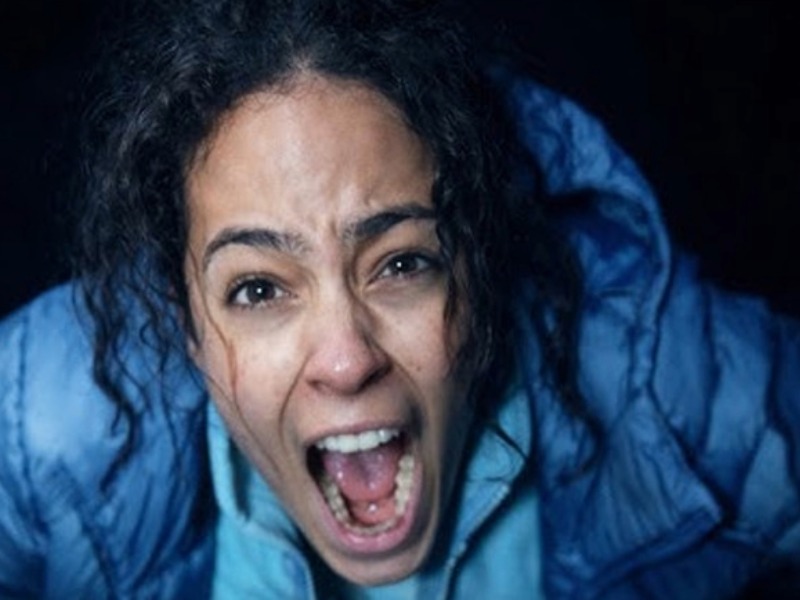
There’s a particular kind of dread that only exists on a highway at 2 a.m. The road ahead is a cone of light and everything outside it has been deleted. The car becomes a small lit room traveling through nothing. You are, in a very literal sense, trapped in a box with whoever is sitting next to you.
Passenger understands this completely. André Øvredal’s lean little road-horror film doesn’t have an original bone in its body, and I’d defend it to anyone anyway, because what it does have is craft — the unfashionable, unglamorous kind. It knows where to put the camera. It knows how long to hold. It knows that a shape in a rearview mirror, correctly framed, is worth more than any amount of mythology.
The setup
Maddie (Lou Llobell) and Tyler (Jacob Scipio) are six weeks into the van life dream — jobs quit, savings converted into a Sprinter, the whole Instagram fantasy. Tyler proposes on a suburban street where they’re technically not allowed to park, which is a nice compressed joke about the gap between the dream and the logistics. Then a neighborhood watch guy moves them along, and they’re back on a dark highway when a car blows past them at panic speed and wraps itself around a tree.
They stop. That’s the mistake. The driver tries to crawl out of the wreck and something drags him back in. In the morning there are three claw marks down the side of their van, matching three claw marks on his.
That’s the whole engine. Something has climbed aboard. It doesn’t need to catch them, because it’s already with them, and it will keep being with them at every gas station, every rest stop, every night for the rest of their lives, however long that turns out to be.
What works
The geography of fear. Øvredal — who made Trollhunter, The Autopsy of Jane Doe, and Scary Stories to Tell in the Dark — has always been better at space than at story, and a van is a gift to a director with that particular skill. Cinematographer Federico Verardi shoots the interior like a submarine: cramped, over-familiar, full of blind spots that the audience learns before the characters do. By the halfway mark you know that van. You know there’s a gap behind the passenger seat. You know the side mirror shows a strip of road you can’t otherwise see. The film spends its first act teaching you the floor plan, then spends the rest of it standing something in the corner of it.
The rules are physical, not theological. The Passenger doesn’t like light. It doesn’t like a St. Christopher medallion — patron saint of travelers, which is the single cleverest idea in the script. It can’t take you while you’re moving through open daylight. These are rules you can act on, and that matters enormously. Bad supernatural horror gives its monster vague, unfalsifiable powers so it can do whatever the scene requires. Passenger gives its monster a set of constraints and then builds setpieces out of characters frantically trying to satisfy them — get to the light, get to the medallion, keep the wheels turning. A flat-tire sequence becomes almost unbearable simply because we know what stopping costs.
Llobell. She’s the film. Maddie is the one who looks at the dashcam footage, who reads the missing-persons flyers at the van-lifer gathering, who notices the stick figure with three lines through it scratched into other people’s belongings. Llobell plays her as a woman whose competence is slowly becoming a liability — the more she understands, the more alone she is, because understanding is the thing Tyler can’t do yet. Her performance holds together an act break where a lesser one would let the film deflate. Scipio is solid but is handed the harder, more thankless job: he has to be wrong for forty minutes.
The Christopher Young score. Young has been doing this since Hellraiser, and his work here is a masterclass in restraint from a composer who’s earned the right not to be restrained. Long stretches are just engine hum and tire noise. The cues arrive late and leave early.
One sequence, in particular. The one where the thing wears a familiar face. I won’t describe it further. It’s the best two minutes of studio horror I’ve seen this year, and it works because the film has spent an hour teaching you to trust exactly one silhouette.
What doesn’t
The Rotten Tomatoes consensus calls it a stylish ride weighed down by clichés, and — irritatingly — that’s fair. This is a curse-movie skeleton with a road-movie skin. You can map it onto It Follows, onto The Ring, onto Drag Me to Hell, without much effort. There is an oracle character who exists to explain the rules and then die. There is a legendary sanctuary that isn’t on any map. There is a final-act lore dump that the film would have been better off refusing.
And the Passenger itself gets less frightening the more you see it. Øvredal shoots it beautifully in glimpses — a shape too still in a mirror, a hand on a windowsill — and then, as these films always do, eventually gives it a full-body close-up. Every reveal is a withdrawal from an account the film can’t refill.
The ending, too, resolves a metaphysical problem with a vehicular one. It’s satisfying in the moment and evaporates on the drive home. Something that has stalked travelers for generations probably shouldn’t be solvable by a Sprinter van and good timing.
So why four stars?
Because I’ve stopped grading horror on originality and started grading it on execution, and on execution this thing is close to immaculate.
At 94 minutes and $15 million, Passenger is a demonstration that the mid-budget studio horror film still works when someone competent is driving. Paramount dumped it onto Memorial Day weekend opposite a Star Wars tentpole with almost no marketing, which is usually the studio telling you something. It wasn’t telling you the truth. Critics landed at mixed — 47% on Rotten Tomatoes, 52 on Metacritic, a B– CinemaScore — and I think a lot of that is the fatigue of recognizing the shape of the thing rather than any real failure of the thing itself.
Watch it as what it is: a genre exercise by a director in complete control of tone, anchored by a lead performance better than the screenplay strictly requires, with a monster whose rules are clean enough to make you lean forward. That’s not nothing. In 2026, with horror mostly splitting between prestige-trauma metaphor and streaming sludge, a tight, mean, well-shot B-picture that just wants to scare you feels close to a public service.
It doesn’t reinvent the wheel. It just rotates it, balances it, and drives the hell out of it.
Verdict: A gorgeously mounted, ruthlessly efficient road-horror that borrows nearly everything except its confidence. Skip the second half of the trailer, drive home the long way, and don’t stop for anything.
RATING: 4/5