Spoiler warning: This post covers the entire plot of Saccharine, including the ending. If you haven’t seen it yet, come back after.
Natalie Erika James made her name with Relic, a horror film about dementia and family. With Saccharine she moves from the haunted house to the haunted body. The film premiered in the Midnight section of Sundance in January 2026 and later reached wider audiences through Shudder. It leaves viewers with a lot of blood and a lot of questions. This post covers what happens, what the ghost is, why the ending lands the way it does, and what it all means.
A Quick Recap: What Is Saccharine About?
Hana (Midori Francis) is a lovelorn medical student who becomes terrorised by a sinister force after taking part in an obscure weight loss craze: eating human ashes. She’s bright, she has supportive friends and loving parents, and she’s attracted to Alanya (Madeleine Madden), a gym instructor who runs a 12-week transformation program. Her best friend Josie (Danielle Macdonald) is the grounded, caring presence who sees Hana unravel.
The film is horror, but it’s anchored in something real. James told the Sundance audience that when you’re in the grips of disordered eating, there’s something outside of your control. The movie turns that feeling into a literal, supernatural fact.
The Gray Pill: How Hana Gets Hooked
Hana’s old classmate Melissa introduces her to a pill nicknamed “The Gray,” which promises fast results without the grind of dieting. As a med student, Hana investigates the ingredients out of academic curiosity and discovers the ingredient list points to human ash. Most people would walk away. Hana doesn’t. She steals a cadaver’s remains from her school to make her own supply.
The pills work. Hana loses weight rapidly, and it feels like a miracle. But the cost is already in motion.
The Ghost in the Spoon: Meet Grace (a.k.a. “Bertha”)
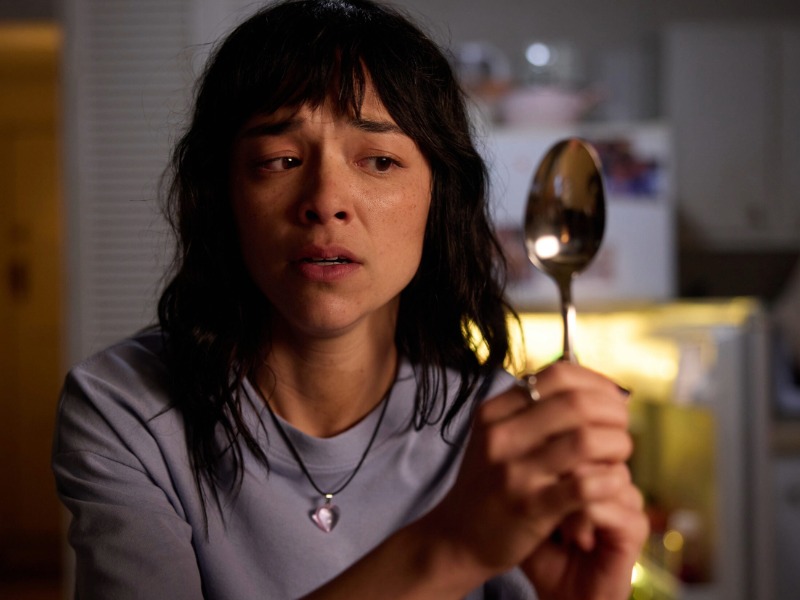
Soon Hana starts seeing an old woman’s reflection in curved surfaces like spoons. The spirit is eventually revealed as a former eating disorder patient named Grace. Hana and her classmates had nicknamed the cadaver “Bertha” before they knew who she was, which is why you’ll see both names in discussions of the film.
The film’s central mechanism is an inversion of the weight-loss fantasy. Grace’s spirit is somehow absorbing everything Hana eats. The more Hana binges, the bigger Grace’s spirit grows, while Hana continues wasting away underneath her own supposed success. Hana “wins” at weight loss only because something else is eating for her. The suffering hasn’t gone anywhere. It has been transferred.
Why Grace Won’t Let Go
Grace’s backstory is the emotional key to the film. She died of liver cancer after a lifetime battling an eating disorder of her own. Her ashes, which should have been her rest, were consumed by another young woman trying to shrink herself, and that effectively drags her back from whatever peace she found in death.
That reframes the haunting. Grace isn’t a vengeful spirit in the traditional sense. She’s a woman caught in the same cycle that defined her life, now repeating through someone new. The horror is that the cycle never ends. Each generation of women passes the same hunger and the same shame to the next.
The physical parallels make this literal. As Hana deteriorates, she develops a tumor in the exact same spot Grace’s cancer once was. Her body is becoming Grace’s body.
The Self-Surgery: Hana’s Desperate Exorcism
This leads to the film’s most extreme set piece. Hana, high on ketamine, cuts herself open to remove the tumor and cut whatever connects her to Grace. In the hallucinatory sequence, Hana feeds Grace the tumor itself, and the spirit vanishes. Other recaps add a detail: Grace rages and pulls at Hana’s organs before Hana forces the tumor into the ghost’s face. Josie steps in and Hana survives.
There’s also a quiet beat afterward. Hana glimpses an older version of herself and feels only compassion for her, which is notable for a character who has long directed spite at herself. For a moment it looks like Hana has found peace, not just escaped a ghost.
The Ending: Hana and Alanya
With Grace gone, Hana seems free. The spirit has stopped following her, and with her life settling, she tries to repair things with Alanya. Their earlier encounter went badly. During a night at Alanya’s place, Grace’s spirit possessed Hana and made her devour everything in the kitchen. Hana was mortified and disappeared on Alanya.
The reunion starts well. Then an intimate moment turns violent, and Hana bites into Alanya with far more force than affection would explain. The film shows in graphic detail that Hana has consumed her, mirroring imagery from a painting seen earlier in her medical school lab. The earlier painting works as foreshadowing, so this isn’t random shock. The film planted the image of devouring long before it paid it off.
As for the closing moments, recaps describe them as deliberately unresolved. Hana isn’t cured. She’s trapped in a loop she may never escape, and it’s left open whether she’s trying to cover up what she’s done or can’t process it.
Did Hana Kill Alanya?
The act itself is shown clearly: Hana devours Alanya. The real question is whose hunger it is. There are three main readings.
Reading 1: Grace is still in control. The ghost didn’t vanish, she just moved deeper. Under this reading the exorcism only worked temporarily, and Grace has returned to finish what she started.
Reading 2: Grace and Hana have merged. A notable detail complicates the first reading. Hana’s eye twitch, her usual tell that Grace has taken over, is notably absent during the attack. That suggests either Grace’s influence has become fully merged with Hana rather than a separate takeover, or that Hana’s own desperate fixation on Alanya has curdled into something monstrous all on its own. If so, there’s no longer a ghost to blame, and the hunger is simply Hana’s.
Reading 3: The craving is the point. Another review frames it as Hana’s literal wish to consume the woman she has desired for so long, adding that Hana has lost all agency and calling the ending heartbreaking. Under this reading the metaphor is about wanting itself. Hana’s longing for Alanya, her longing to be thin, and her hunger have all collapsed into one appetite she can’t govern.
I find Reading 2 the most thematically satisfying, because it removes the comforting idea that the problem was an external monster. But the film deliberately keeps all three alive.
What the Ending Really Means
1. Disordered eating isn’t “cured” by removing the symptom. Hana cuts out the tumor and feeds it to the ghost, a dramatic and visual solution. Real recovery is slow and unglamorous, and one reviewer pointed out that the days or weeks of story time aren’t nearly enough to undo years of troubled thoughts. The ending makes the same point in horror terms. The visible threat is gone, but the underlying hunger isn’t.
2. Desire and hunger become the same thing. The film uses a queer romance as the emotional counterweight to Hana’s body-image horror. Alanya is both the object of desire and the standard of thinness Hana feels she can never reach. By the end, “wanting her” and “consuming her” are the same act. The painting in the lab hints that this was always the film’s grammar.
3. The cycle continues. Grace was haunted by the same thing as Hana, and Hana now carries it forward. The ending suggests the pattern doesn’t break neatly, and that it can even harm the people closest to you.
4. Cultural pressure is the real monster. James has said the film is shaped by a culture that teaches us to be at war with our bodies. The ghost is a way to make that abstract pressure physical. When the ghost’s rules stop mattering at the end, what’s left is the culture and the self-hatred it taught.
Is the Ending Satisfying? Critics Are Split
Reception to the finale has been mixed, and it’s worth knowing. One reviewer felt the ending breaks its own logic a little, and it’s the one moment where James seemed less than fully confident. Another argued the last scene is unnecessary shock value reductive to the themes being explored. Others found the film’s tonal balance more successful, with one praising James as a confident, daring filmmaker who can provoke meaningful conversations while still sending chills up our spine.
My take is that the ending works best if you accept its ambiguity. If you need a clean rule, such as “Grace did it” or “Hana did it,” the film will frustrate you. If you read it as a statement about hunger that has no clean off switch, it holds together much better.
Quick FAQ
What is Grace in Saccharine? The spirit of a woman who battled an eating disorder all her life and died of liver cancer. Her ashes are what the Gray pills are made from, which is why she attaches to Hana.
Why is Grace called Bertha? It’s the nickname Hana and her classmates gave the cadaver before they knew her identity.
Does the self-surgery work? Seemingly, for a while. Grace vanishes after Hana feeds her the tumor, but the ending shows the hunger returning in a worse form.
Who saves Hana? Her best friend Josie steps in after the self-surgery.
Does Hana kill Alanya? Yes, Hana consumes her. Whether Grace, Hana, or both are responsible is intentionally left open.
Is there a post-credits scene? I couldn’t find any source confirming one.
A note for readers: Saccharine deals heavily with disordered eating. If the film hit close to home, support is out there, and talking to someone you trust or a healthcare professional is a good step.