Spoiler warning: This post covers the entire plot of Kinki (近畿地方のある場所について, also released as About a Place in the Kinki Region), including the twist and the final scene.
Koji Shiraishi is the director behind Noroi and Sadako vs. Kayako, and Kinki is his adaptation of Sesuji’s viral web novel. The NYAFF describes the source as a viral web novel that became a major horror sensation in Japan. Nippon.com adds that it was a popular online serialized novel that captured imaginations in 2023 with eerie tales that had readers unsure whether they were fiction or reality.
The film starts as a slow, document-driven mystery and turns into something much stranger by its final act. Here’s what happens, who is behind it, and what the ending is telling us.
A Quick Recap: What Is Kinki About?
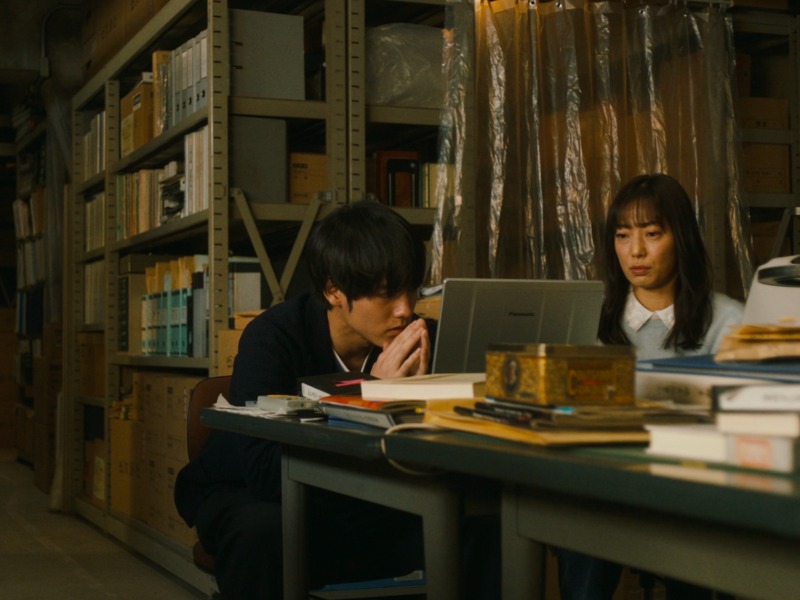
Sayama (Atom Shukugawa), the editor of an occult magazine, vanishes just as he’s about to publish the biggest story of his career. His junior colleague Ozawa (Eiji Akaso) has to finish the feature or the magazine gets shut down. Ozawa brings in a freelance occult writer, Chihiro (Miho Kanno), to help him assemble the article from the materials Sayama left behind, such as paper documents, news articles, and video tapes.
The film stays in found-footage territory for much of its length. Reviewers praised how well it keeps the structure of the novel. One wrote that the central mystery is addictive and frequently creepy as the search through forbidden and lost knowledge slowly builds an eerie atmosphere.
The Clues: Videos, Charms, and a Mysterious “Ooii”
The archive Chihiro and Ozawa dig through contains several seemingly separate incidents:
- A little girl who goes missing near her home. Her uncle later throws himself into a dam, and a passerby sees the girl in the forest with black eye sockets.
- A school trip where the students hear a call of “Ooii” from the forest at night. One girl mocks it and collapses.
- A man visiting a small shrine full of dolls. At the end of his video, he raises a hand, and the “Ooii” is heard again.
- A streamer who breaks into a haunted house with a room whose ceiling is covered with nooses.
- A cursed video that tells viewers they will die if they watch it, shared by a college student named Meguro.
Every thread leads back to the same drawing: a stick figure in front of a torii gate, with kanji in the corners. The only differences are the kanji and whether the figure is a man or a woman. This charm turns up in news footage of a vanished family, outside a witness’s house, and on posts from people across Japan. It’s the film’s visual signature, a kind of curse watermark.
They also find a children’s game called Mashira-sama, a form of tag in which the person who catches you must be offered something. Before starting the chase, the tagger calls “Ooii.”
The Folktale of Masaru
The pieces come together through a folktale. A boy named Masaru loves his mother, and when she dies he cries all night. A god offers him a wish, but instead of bringing back his mother, gives him a persimmon and tells him that whichever woman eats it can become his wife. Masaru climbs the mountain and cries out to girls to eat it, but no one comes, and he dies from exhaustion without a wife.
After that, people on the mountain could hear Masaru calling. Frightened, they built a shrine. So the “Ooii” is Masaru’s call, and everything in the footage is a result of that unfulfilled longing. The offering, the call, the dolls in the shrine and the missing girls all connect to him.
The Rules of the Curse
By the midpoint, the survivors in the footage reveal a set of rules, which are part of what makes the film feel like a grim puzzle:
- Meguro is told to keep raising living things. He keeps animals and replaces each one the moment it dies, because the day his killifish died, a woman appeared on his balcony with raised arms. The priest who advised this, and who didn’t follow it himself, later dies.
- Watching the cursed footage spreads the problem. Sato, who sees the “if you watch this, you die” video, withdraws and disappears.
- The entity seems to move through chain-message logic, and one of the clips even involves text messages demanding they be forwarded to three people.
The film borrows the grammar of internet creepypasta and urban legend, which is why it feels so familiar and so unsettling.
Sayama’s Final Warning
Ozawa is possessed for a stretch and Chihiro has to slap him out of it. At her home, he notices a photo of her dead son, Takumi, and learns that a writer helped Sayama escape. They track Sayama to a remote cabin. The smell hits first, the smell of all the dead animals he kept. Then Sayama appears behind them, and his possessed wife arrives on all fours.
Sayama warns Ozawa that Chihiro has been deceiving everyone and that Ozawa will be her next target after Sayama. Before dying, he hands over a USB drive. In graphic fashion, he takes his own life by pushing his empty eye socket onto a fence.
The footage on the drive shows Amano Iwayato, a religious cult-like group where people who have lost their loved ones come together to pray to bring them back. Chihiro is among the women in the video.
The Big Twist: Chihiro Was Never the Hero
Chihiro admits that after her son was murdered, she joined the group. The group worshipped a black stone that appeared one day in a courtyard and later vanished, which broke up the organization. Chihiro and Ozawa follow rumors that the stone has reappeared at Masaru’s shrine. Chihiro drives straight through the spirits blocking the road, throws away the shrine’s dolls, and smashes the shrine apart looking for the stone.
She realizes something important: whoever is in dire need, the stone appears to them. At a tree standing in the middle of a pool of water, the black stone appears behind her. She thanks Ozawa for coming and says she is also in need. A huge, octopus-like figure with many eyeballs appears from the tree, and the eyes roll toward Ozawa and consume him. He disappears into the stone.
The film then reveals that Chihiro has been the force steering the investigation all along. One Japanese fan blog describes the twist as that she was actually the mastermind using the apparitions to manipulate Ozawa for her own desires, and calls it a subversion that doesn’t betray the setup. Looking back, many earlier moments change meaning: her insistence that Ozawa not investigate alone, her knowledge of the cult, and her convenient ability to read the evidence.
The Final Scene: The Baby’s Cry
A minute after Ozawa is taken, a baby cries. The film cuts to a video of Chihiro publicly asking people to help find “her friend” Ozawa, who disappeared during their investigation. In the footage, a baby’s cry sounds on phones everywhere. Chihiro brings the baby out to soothe it, and in the last second the baby begins to take on the same tentacle-like structure as the creature in the tree.
High On Films reads the ending this way: Chihiro had to make a series of sacrifices to bring her child back to life, but the child that returns no longer seems fully human, more like a demon reborn. The cry is heard through thousands of phones at once, which suggests the curse has now spread to everyone. And Chihiro herself seems transformed, almost as if she has become a servant of the entity lurking within the forest.
A small production note: the Japanese blogger mentions that while the baby looks to many viewers like a “spiritual earthworm,” the director has said it isn’t. So what the baby actually is remains open.
Ending Explained: What Is Really Happening?
1. The black stone grants wishes to the desperate. It appears to people in need, as the film shows through Chihiro. But it follows the same logic as Masaru’s story: a wish granted by the wrong kind of god, with a terrible price.
2. Chihiro was feeding the entity. Her investigation, her recruitment of Ozawa and her destruction of the shrine were all steps toward getting the stone. Ozawa was the sacrifice she needed, and Sayama’s earlier warning was the truth.
3. The baby is Takumi, brought back. Within the film’s logic, Chihiro’s dead son returns, but changed. The tentacled transformation suggests he now belongs to the thing that revived him.
4. The curse goes viral. The baby’s cry mirrors Meguro’s cursed video, with one major difference: the video at least came with a warning. This one is broadcast without any. That makes the ending a modern curse story in which exposure alone is infection, which is the same logic as chain messages and viral videos.
Themes: Grief, Obsession, and the Internet as a Haunted House
Grief as a monstrous force. The sympathetic, capable heroine becomes the villain through love for her dead child. Masaru’s story is also about a child who can’t let go of a dead mother. Both cases center on grief refusing to end.
The cost of every wish. Nobody in this story gets what they want without paying for it, and the person paying is rarely the one who made the wish.
Curses that spread like content. The film frames a haunting as something that travels through footage, posts and phones. The final cry through everyone’s devices makes the audience part of the story.
Does the Ending Work? Critics and Fans Are Split
Reception to the final act is divided. Some viewers loved how it shifts tone. One fan describes the last 30-40 minutes as a departure from the found-footage style, where Shiraishi’s personality fully explodes, and notes that people unfamiliar with his style may have found the second half hard to follow. The same writer observes that fans of the original novel might feel let down because the found-footage first half was so strong.
Others took to it immediately. One reviewer wrote that despite a quite unpleasant ending, it left an aftertaste that somehow made me want to say it was ‘fun.’ Another review captures the film’s lingering unease, saying that the scariest thing may be that at the end of the trail there are no answers, only more questions.
My own read is that the ending works best if you treat the first half as a puzzle and the second half as a character tragedy with a monster attached. If you want a clean “rules of the curse” payoff, you may be disappointed. If you accept that the movie’s real subject is Chihiro, it clicks.
Quick FAQ
What is “Ooii”? The call of Masaru from the mountain, heard in nearly every incident in the footage.
What is the paper charm? A drawing of a figure before a torii gate, with kanji in the corners. It marks places and people affected by the curse.
What is the black stone? The object that appears to people in desperate need and ties together the cult, the shrine and Chihiro’s story.
Did Chihiro know the truth all along? The twist strongly indicates she did, or at least that she steered the investigation toward the stone from the start.
What happened to Ozawa? The entity’s eyeballs consumed him and he vanished into the black stone.
Is the baby Chihiro’s son? That’s the most common reading, though the film never says it outright, and the baby’s final transformation implies he’s no longer human.
Is there a post-credits scene? I couldn’t confirm one from the sources I found.
I can turn this into a downloadable Markdown or Word file, add an SEO title and meta description, or cut it into a shorter version if you’d like.