Spoiler warning: this review discusses the plot, including the ending.
Some films are built on a premise so good that you want them to succeed on the premise alone. The Last House is one of them. A family wakes up, steps toward the door, and finds the whole house sealed shut. The doors won’t open, the windows won’t break, and the outside world has gone silent. It’s the sort of idea that sells itself in a single sentence and fills you with dread before the first frame.
It’s a shame, then, that the film can’t sustain what it sets up.
The setup
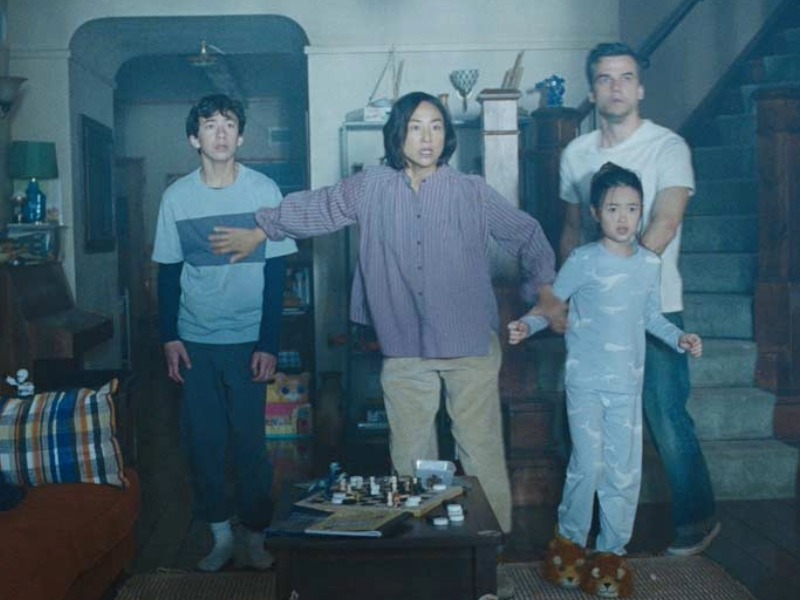
The film follows Jason Delgado, an unemployed engineer who gets home to suburban Seattle just as an odd-looking storm rolls in, only for his family to discover that none of the doors or windows will open and that their neighbors are trapped too. Jason (Wagner Moura) and his wife Ann (Greta Lee) have two kids, Graham and Ruth, plus a dog named Cassidy. The electricity and water keep working for now, so the film doesn’t begin as a race against the clock. It begins as a question of how you live inside a mystery you can’t investigate.
This is where The Last House is at its best. The early stretch is a practical, almost procedural survival story. The family starts rationing, Ann plants an indoor vegetable garden, and Jason improvises a water reclamation system. The film clearly enjoys the problem-solving of domestic survival, and there’s a quiet pleasure in watching a family turn a suburban home into a self-contained ecosystem.
The cast carries it
Greta Lee and Wagner Moura deserve most of the credit for the film being watchable at all. Both are playing parents who have to project calm for their children while privately unraveling, and both find texture in what could have been stock roles. Moura plays Jason as a man whose competence is also his coping mechanism: if he can fix the next thing, he doesn’t have to think about the big thing. Lee’s Ann is the more watchful of the two, and her scenes with the kids carry the film’s few real emotional beats.
I’m not alone in thinking so. The Hollywood Reporter’s David Rooney felt the film leans heavily on its two leads to elevate a script that never delivers a satisfying conclusion. That’s about right. Remove the performances and there isn’t much holding this together.
The child actors do solid work too, especially in the later stretches when the story jumps forward and the kids have to carry more weight. The film spends its time wisely on Ruth, who is the first to notice something moving outside in the rain. The adults dismiss it as imagination, which is a familiar horror beat, but it works because the film trusts the audience to feel the dread before the characters do.
The best idea in the film
The sequence I’d single out is the time jump. After the first couple of months and the death of their neighbor Susan at the hands of a creature, the story leaps ahead five years, by which point the family has pushed the garden through the living room floor and threaded water systems through the whole house. It’s a striking image: a home slowly digested by the family’s need to survive in it. The kids, now older, are worn down and openly questioning whether any of this is worth it.
This is the thematic heart of the movie, and it’s a good one. The film is really asking what survival is for. Jason and Ann can justify every ration and every trap because they’re keeping their children alive, but the children themselves are the ones living with the cost. A house that was meant to protect them has become a very comfortable cage, and the film gets real tension from the gap between parents who want to endure and kids who aren’t sure endurance is a life.
If the film had stayed in that register, it might have been something special.
Where it loses its grip
It doesn’t, unfortunately. The pacing is the first problem. By the time the story reaches its midpoint, the film has largely exhausted its supply of fresh ideas, and it starts repeating its moves: another round of scarcity, another close call, another conflict that resolves in the same way. Critics were consistent about this. NME’s Victoria Luxford gave it two stars and argued that the payoff wasn’t worth the wait.
The second problem is the shift in genre. Roughly an hour and ten minutes in, according to one reviewer, the film flips from a slow-burn survival story into something closer to a monster movie. I understand the impulse, since a film with an unseen threat eventually has to decide what to do with it, but the transition is awkward. The mystery that gave the opening its power is spent as soon as the creatures take center stage. As Rooney put it in his review’s headline, the film is most effective while the threat remains unknown, and the film seems to lose track of that.
Then there’s the ending. When the family traps one of the creatures, Jason stops short of killing it at Ruth’s insistence, and in response the creature opens the front door, tells the others to leave them and the planet alone, and the house collapses into a sinkhole. The world outside is almost entirely flooded, and the family sets off by boat, searching for other survivors by radio.
I can see what the film is going for. It’s a story about mercy, about a child’s compassion succeeding where the adults’ paranoia failed, and there’s a nice symmetry in Ruth being the one who first noticed the creature and the one who spares it. But it plays as too neat and too sudden. Years of confinement and a family’s slow psychological erosion get resolved by a single act of kindness and a creature with a change of heart. The film hasn’t built enough of a case for why the creatures would respond this way, so the resolution feels like a convenience rather than an earned payoff.
How it fits into the genre
It’s easy to see the DNA of 10 Cloverfield Lane and Leave the World Behind here, and the film invites the comparison. At first glance it looks like a movie inspired by COVID, and the lockdown parallels are hard to miss. A family sealed in a home, unsure what’s happening outside, learning to ration and stay sane: it’s a post-pandemic anxiety dream.
But those comparisons are also unflattering. 10 Cloverfield Lane kept you guessing right up to its final act because the danger was as much inside the room as outside it. The Last House never builds that kind of interpersonal pressure. The Delgados are a loving, functional family, which is nice to watch but removes a source of tension the genre usually exploits.
The verdict
The critical consensus is not kind. On Rotten Tomatoes the film sits at 22% positive across 78 reviews, and Metacritic scores it 42 out of 100. That feels a touch harsh to me, because the film isn’t incompetent. Leterrier stages the claustrophobia competently, the production design makes the house feel lived-in and then gradually cannibalized, and the performances are strong.
The more generous reviews seem to have landed on the right framing. The Guardian’s Benjamin Lee called it just about good enough for a low-stakes click, while Empire gave it three stars and called it a perfectly good way to spend a couple of hours. That’s the right expectation to bring. This is a perfectly fine Friday-night streaming watch, and not a film that will linger.
What works: The early survival-procedural stretch, the five-year time jump, Lee and Moura, and the central question of whether survival is the same thing as living.
What doesn’t: The repetitive middle, the clumsy turn into monster-movie territory, and a tidy ending that doesn’t earn its resolution.
If you want a film about being trapped, with real tension and real stakes, there are better choices. If you want something low-pressure to watch on a rainy night, with a couple of memorable images and good acting, The Last House will do. Just don’t expect it to reward you for sticking around until the end.
RATING: 3/5