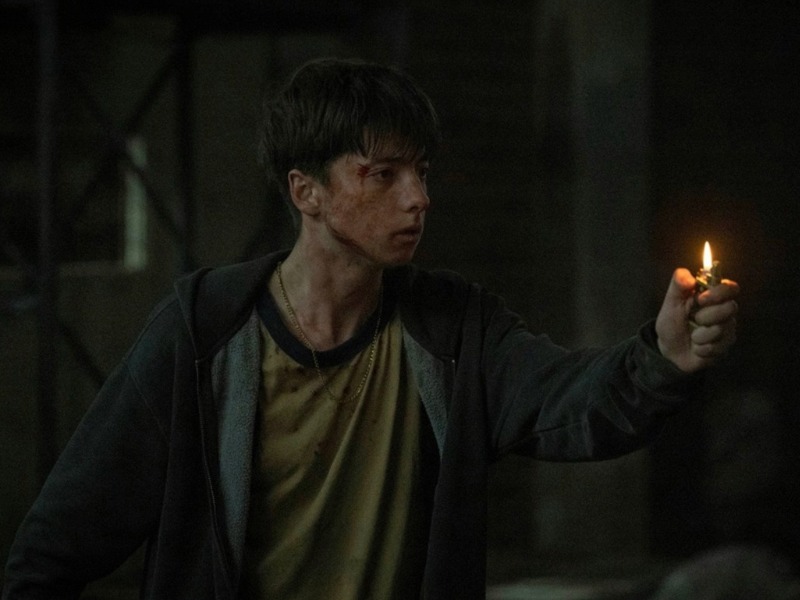
Most horror movies about repression treat the metaphor as a garnish. Leviticus makes it the engine of the whole film. Adrian Chiarella’s debut starts from a cruel premise and then follows it through without flinching: two teenage boys must escape a violent entity that takes the form of the person they desire most, each other. The monster isn’t something that attacks love from outside. It is made of love, after it has been bent by fear.
The setup
The film is set in a conservative religious community in rural Victoria. Naim (Joe Bird) and Ryan (Stacy Clausen) are in the first flush of young love and keep their relationship secret. The title points at the Old Testament book that gets quoted whenever someone wants scripture to condemn homosexuality. One critic noted that the book’s reputation for odd prohibitions, including the one about homosexuality, tells you what the subtext will be.
The catalyst is a religious leader’s attempt at conversion therapy. It fails to change anything and instead unleashes an unknown being. Chiarella has said the film draws on testimonies from LGBTQ+ young people subjected to conversion practices. That grounding matters. The horror doesn’t feel like genre dressing laid over an issue. The supernatural makes literal a violence that already exists, and in this film the monster is the tool a community uses to try to suppress homosexuality.
A love story first
The film’s best decision is to make you fall for Naim and Ryan before it starts hurting them. It opens with a violent kill, but then it slows down. It takes its time building the tension and pressure between the two boys. Their scenes together are tender and sometimes sensual, and they feel lived in. One review praised a strong, beautifully realised and occasionally sensual relationship, backed by two terrific central performances. I agree.
This is where the film earns its horror. A creature that wears the face of your beloved only frightens you if you believe in the beloved. By the time the entity shows up, the film has convinced you that Naim and Ryan are the one safe thing in each other’s lives. The monster works by turning that safe thing into a threat, and it is hard to watch.
Joe Bird, who some will remember from Talk to Me, and newcomer Stacy Clausen are what make this work. At the Sundance premiere, Chiarella said he knew he had the film once he saw the two actors together. It shows. Their performances are open and unguarded, so the surreal turns later in the film have something real to land on. The adult cast has a lighter role, but Mia Wasikowska, Ewen Leslie and Nicholas Hope bring the right kind of weight to the community that stays in the background, watching and judging.
Craft: place, texture, dread
For a debut, the film has a very strong sense of place. The small town feels grim and closed in, a place where everyone knows everyone and privacy is a luxury. One critic called its sense of place incredibly vivid. The cinematography supports that, keeping the boys in ordinary surroundings so the intrusions feel more violating.
Chiarella’s influences are easy to spot. Critics have compared it to It Follows, and the French listing for the film also names The Thing and Kiyoshi Kurosawa’s Cure as inspirations. The It Follows connection is the clearest: a relentless pursuer, a feeling of inevitability, and a monster that is also a metaphor. The shapeshifting paranoia of The Thing shows up in how the entity can be anyone you love, and the quiet menace of Cure in its patience. The film wears these influences openly but doesn’t copy them.
It also comes from a good lineage. It was produced by Causeway Films, the outfit behind Talk to Me and The Babadook, and it feels like part of that wave of Australian horror that puts emotional stakes ahead of cheap shocks.
Where it stumbles
It isn’t flawless. Comparing it to It Follows works against it in one respect: it never matches that film’s tension, and one jump scare feels out of place and ineffective. I’d add that the film is built around a particular ending, so a few middle-act set pieces serve the destination more than the scares. Another review makes the same point: with the film heading toward such a specific conclusion, some middle-act scares don’t register. If you want relentless, rhythmic set pieces, you may feel a lull.
At 88 minutes the film is lean, and I felt that mostly as a strength. Still, a few secondary characters, the adults and the wider community, are sketched more than explored. The film is about these two boys, and I think that focus is right, but it leaves the community feeling a little like a faceless chorus.
Themes: the cruelty of “help”
The film’s thematic work comes down to two questions. First, where does the monster come from? Chiarella doesn’t simply blame religion, and one review noted that the film doesn’t discreetly place the blame on all organized religion as being distinctly evil. The target is narrower and more honest: the fear, control and moral certainty a community uses when it decides that love is a disease.
Second, what does that cost the people it is done to? Read as a whole, the film is about internalised and externalised homophobia, and the way the outside voice becomes the inside voice. The most frightening thing the entity does is not the violence but the way it makes the boys doubt whether what they feel is safe. That is the real wound of conversion therapy, and the film understands it.
One reading of the film argues that parents who turn away from their children’s pleas for understanding are the deepest horror in the story. I think that reading gets at something true about the film’s emotional register. This is a film about adults failing children, and the monster is only the visible form of that failure.
The ending (light spoilers)
I’ll keep this vague. The film ends ambiguously, without clarifying whether the entity will ever leave the lovers now that they are moving away from the town. The closing moments, scored with a Frank Ocean track, were described by one Sundance viewer as both bleak and strangely freeing. That’s a good description of the tonal needle the film threads. It doesn’t offer comfort, but it offers something harder to find: the sense that the two of them choosing each other is the only act of defiance that matters.
I think the ambiguity is correct. A clean victory would have undercut the film’s argument, which is that this kind of harm doesn’t conclude neatly when you leave the town.
Reception and context
Leviticus premiered in the Midnight section at Sundance in January 2026, and sold to Neon for mid-seven figures as the first deal of the festival. It then played Sydney Film Festival, opened in Australia on June 18 and in the US the next day, and reached US streaming on July 28. Critical response has been strong: a 95% on Rotten Tomatoes at the time of the New Directors/New Films opening, and at launch on the Letterboxd Video Store it ranked in Letterboxd’s Top 250 Horror Films. In a year already crowded with strong horror, it holds its own, and some critics think it stands apart from the pack.
Verdict
Leviticus is not the scariest horror film of 2026, and it isn’t trying to be. It is something rarer: a horror film where the fear and the heartbreak come from the same source. The scares are uneven, and the ending won’t satisfy anyone who wants answers. But the central relationship is so convincing, and the central idea so cruelly well executed, that it stays with you.
If you’re someone who found It Follows more moving than frightening, or who thinks queer horror works best when it is sad, this is for you. Be ready, though: it’s a film about people being hurt for loving each other, and it doesn’t pretend otherwise.
Watch it if you like: It Follows, Talk to Me, Boy Erased with a supernatural edge, slow-burn small-town dread
Skip it if: you want constant scares, or you’re not up for a bleak emotional ride
RATING: 3/5