How do you make a sequel to a self-contained horror film where the villain died at the end and the story felt completely resolved? Simple: you turn him into Freddy Krueger.
That’s exactly what director Scott Derrickson and co-writer C. Robert Cargill have done with Black Phone 2, transforming Ethan Hawke’s child serial killer The Grabber from a grounded basement kidnapper into a supernatural nightmare monster who can torment from beyond the grave. It’s a radical shift in tone and concept that had every right to fail spectacularly—but somehow, against all odds, it mostly works.
With a solid 70% on Rotten Tomatoes from critics but wildly divided audience reactions, Black Phone 2 is 2025’s most polarizing horror sequel. Some call it a rock-solid example of how to expand a standalone story without repeating yourself. Others dismiss it as an exhausting Nightmare on Elm Street rip-off that forgot to bring compelling nightmares.
Having watched it, I land firmly in the “flawed but fascinating” camp. This is a sequel that takes genuine creative risks, delivers legitimately terrifying imagery, and understands the thematic DNA of the horror it’s homaging—even when it stumbles over its own ambitions. It’s too long, occasionally repetitive, and leans too heavily on dream logic for some viewers’ tastes. But it’s also bold, beautifully shot, and features some of the most disturbing visuals in mainstream horror this year.
Let’s break down what works, what doesn’t, and whether this unnecessary sequel earns its existence.
The Setup: Four Years Later, The Phone Rings Again
Black Phone 2 takes place in 1982, four years after Finney Blake (Mason Thames) became a national hero as the only survivor of The Grabber—and the boy who killed him. But surviving doesn’t mean healing. Now 17, Finney is angry, violent, and numbing his PTSD with drugs and fights. He’s still hearing voices from the supernatural realm, unable to find the peace that The Grabber’s other victims found in death.
His younger sister Gwen (Madeleine McGraw), now 15, has inherited their mother’s psychic abilities and struggles with the weight of that gift. She wants a normal life—to go to concerts, date boys like Ernesto (Miguel Mora), and not be defined by visions she can’t control.
Then the dreams start.
Gwen begins receiving calls in her sleep from the black phone, hearing their dead mother’s voice warning her about three boys being stalked at a winter camp called Alpine Lake—the same camp where their mother once worked before her mysterious death. The visions are grainy, disturbing, and show children being murdered in ways that feel sickeningly real.
When Gwen and Finney research Alpine Lake, they discover a pattern: children have been disappearing from this camp for years, always during winter, always without explanation. Determined to end the torment for both herself and her brother, Gwen convinces Finney to visit the camp during a winter storm.
What they find is worse than either imagined: The Grabber isn’t gone. He’s evolved. Operating from the dream world like Freddy Krueger, he’s seeking revenge on Finney by targeting Gwen and the vulnerable boys at the camp. And in this snowbound, isolated location where reality and nightmare blur together, the siblings must face not just The Grabber’s ghost—but the trauma they’ve never fully processed.
What Works: Genuinely Terrifying Imagery
Gwen’s Visions Are Nightmare Fuel
The absolute standout element of Black Phone 2 is Gwen’s dream sequences. Shot on grainy Super 8mm and 16mm film stock, these visions have a disturbing, snuff-film quality that gets under your skin in ways the first film never attempted.
Derrickson pulls no punches: children are shown being stalked, terrorized, and murdered with graphic brutality. One vision features a boy’s face split in half by window glass, the severed portions continuing to move independently. Another shows The Grabber’s rotting form dragging a screaming child across ice. These aren’t jump scares—they’re sustained sequences of dread that feel genuinely transgressive.
As one reviewer noted, Black Phone 2 is messed up in ways that big-budget movies from major studios are rarely allowed to be, with images of children traumatized by violence that are legitimately terrifying. The first vision Gwen has after arriving at camp is true nightmare fuel.
The grainy texture makes these sequences feel like forbidden footage—something you shouldn’t be watching. They got under my skin more than anything in the first movie, and I suspect they’ll haunt viewers long after the credits roll.
The Grabber’s Transformation
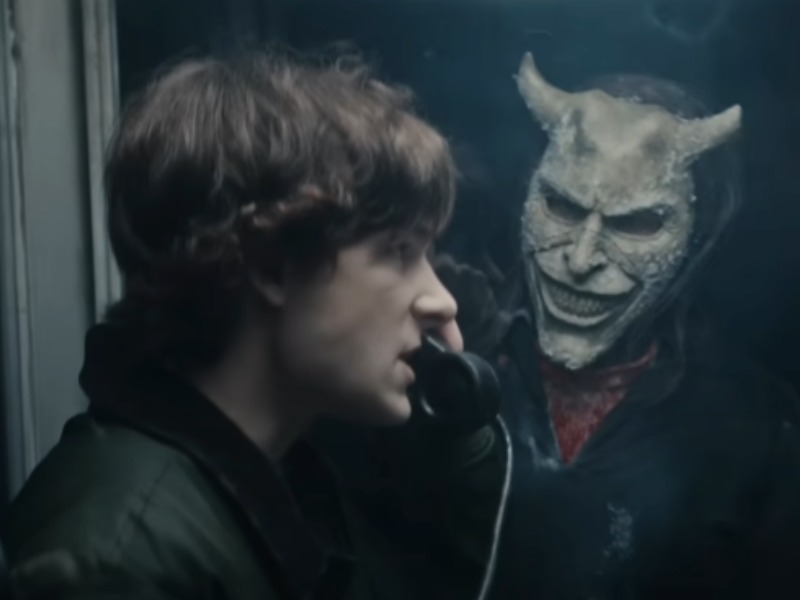
Ethan Hawke returns, and while his screen time is limited, his presence looms over every frame. The makeup team deserves serious credit: The Grabber is now a rotted, monstrous figure—flesh decaying, mask crumbling, barely recognizable as human.
Unlike the first film where he was a flesh-and-blood kidnapper (terrifying but mortal), supernatural Grabber can appear anywhere, anytime, in dreams or reality. He’s genuinely menacing in ways the grounded original couldn’t achieve. Every time he shows up, the film gets ten times creepier, and Hawke’s performance—making tiny, demented acting choices—elevates what could have been a one-note ghost villain.
Scott Derrickson’s Visual Mastery
Derrickson proves once again why he’s one of horror’s most visually accomplished directors. The film is gorgeously shot by cinematographer Par M. Ekberg, with sequences that feel genuinely cinematic.
The standout moment: Finney in a phone booth surrounded by snowy tundra. As Derrickson’s camera begins to pull back and circle the booth, the displaced souls of murdered children appear in the distance, revealed through the camera’s rotation. It’s a sequence that turns a simple phone call into a full-blown visual event—claustrophobic intimacy expanding into cosmic horror.
The film uses film grain and texture to create atmosphere that digital photography simply can’t replicate. Like the original, Black Phone 2 feels like a picture made decades in the past, giving Alpine Lake an authentically arctic, isolated quality.
The Nightmare on Elm Street Homage Actually Works
Yes, this is basically “What if The Grabber became Freddy Krueger?” And yes, the Nightmare influences are impossible to miss. But here’s the thing: Derrickson and Cargill actually understand the thematic heft behind the best Elm Street films, particularly Dream Warriors.
They’re not just imitating the surface-level dream logic—they’re exploring the same themes of trauma, survivor’s guilt, and how the dead can haunt the living through memory and fear. The references feel like genuine homage from filmmakers who love and respect the source material rather than hollow mimicry.
There are two set pieces late in the film—one in a kitchen where the Freddy/Grabber connection becomes explicit, and one in a phone booth where things get extremely bloody—that Wes Craven would have adored. It takes genuine talent to understand how those classic horror mechanics work and make them your own instead of just echoing them.
The Snow Setting
Horror doesn’t use winter settings nearly enough, and Black Phone 2 fully exploits the icy, isolated atmosphere of a snowbound camp. The frozen lake, the blizzard conditions, the questionable ice stability beneath characters’ feet—it all creates a sense of environmental danger layered on top of the supernatural threat.
The climactic showdown on the ice is remarkably conceived and executed, delivering a chilly and gory finale to remember. Few non-Christmas horror films are set in snowy tundra, and the novelty adds genuine freshness.
What Doesn’t Work: Repetitive Dream Logic Kills Suspense
The “Sleep, Dream, Wake Up” Formula Gets Exhausting
Here’s Black Phone 2‘s fatal flaw: the entire movie is stuck on repeat. For nearly two hours, characters fall asleep, have disturbing dreams, wake up, process what they saw, then fall asleep again. After the first 30 minutes, the pattern becomes predictable and numbing.
Multiple frustrated viewers noted this exact problem: “Every time the story starts to pick up, boom—someone falls asleep again. Cue another dream, another spooky phone call, another fake-out scare. It gets predictable fast.”
The biggest issue is that dream logic kills the suspense. When half the movie happens while characters are asleep, the danger doesn’t feel real anymore. You stop caring who’s in trouble because you know they’ll just wake up again. Stakes evaporate when you can’t tell what’s dream and what’s reality, and “it was all a dream” becomes the answer to every cliffhanger.
By the end, you don’t feel scared—you just feel tired.
It’s Way Too Long
At 114 minutes (nearly two hours), Black Phone 2 overstays its welcome significantly. The story could easily have been wrapped in 90 minutes, and many viewers felt the pacing dragged unbearably in the middle section.
There’s an entire stretch—roughly minutes 30-70—where the film spins its wheels, repeating the same dream-wake-dream pattern without advancing the plot meaningfully. Characters have the same conversations multiple times. We see similar nightmare imagery again and again. The tension that should be building instead dissipates through sheer repetition.
One brutal assessment: “Easily one of the worst movies I’ve seen in the last 5 years. Wasn’t scary. Wasn’t exciting. Wasn’t dramatic. Also it was way too long for what is basically a boring movie. The first hour a bunch of people were talking during the movie. The second hour they were completely silent. My guess is they fell asleep.”
Too Much Exposition
For a film that works best when leaning into surreal nightmare logic, Black Phone 2 spends far too much time explaining itself. There’s an extended middle section that becomes a slog of backstory, mythology building, and characters discussing what everything means instead of just showing us.
At times, the film strays too far into unnecessary exposition—in horror, ambiguity is often more powerful than explanation. The original Black Phone benefited from leaving certain supernatural elements mysterious. The sequel feels compelled to explain everything: how the phone works, why The Grabber can return, what their mother’s connection to the camp was, the exact rules of the dream world.
It’s a classic case of a sequel thinking it needs to answer questions nobody was really asking.
Finney’s Story Feels Undercooked
Despite being the protagonist of the first film and ostensibly co-lead here, Finney’s arc feels rushed and underdeveloped. For a character dealing with severe PTSD, the film doesn’t give us enough time to really sit with his trauma.
His angry, violent behavior is established quickly, then not explored with the depth it deserves. His journey toward healing happens largely off-screen or in quick montages. By the time he reaches his emotional catharsis in the finale, it doesn’t feel fully earned because we haven’t walked that path with him.
The film smartly shifts focus to Gwen—making her the true protagonist was the right call—but that leaves Finney feeling somewhat sidelined in his own sequel.
Tonal Wobbles
Black Phone 2 can’t quite decide if it wants to be a straight-up horror film or lean into the camp inherent in its Nightmare on Elm Street homage. There are stretches where it feels a little goofy, like it doesn’t know if it wants to be taken seriously or acknowledged as pulpy fun.
Some moments land as genuinely scary. Others feel unintentionally comedic. The shifts between these modes are jarring rather than balanced, and viewers expecting pure horror may be put off by the campier elements, while those expecting more fun may find it too self-serious.
The Divided Reception: Why Some Love It, Others Hate It
The 70% critics score versus wildly mixed audience reactions tells the story: this is a film that polarizes based on what you value in horror sequels.
The “It’s Great” Camp
Reviewers who loved it praised:
- Genuinely terrifying dream sequences
- Bold creative risks that expand the original
- Ethan Hawke’s monstrous return
- Gorgeous cinematography and snowy setting
- Understanding the Nightmare on Elm Street DNA
- The climactic ice showdown
Roger Ebert’s site called it “a creepily inventive shocker that grows in mournful power as it moves along.” Flickering Myth awarded it 3/5 stars: “Between Gwen’s terrifying visions, the snowy setting, and The Grabber’s decayed return, there’s plenty here that lingers after the credits roll.”
Reelviews praised how it “expands the canvas rather than simply tracing over the elements and plot points of its predecessor,” succeeding where M3GAN 2.0 failed by crafting a worthwhile sequel from a seemingly exhausted premise.
The “It’s Terrible” Camp
Viewers who hated it cited:
- Boring, repetitive dream sequences
- Exhausting “sleep-wake-repeat” formula
- Too long with sluggish pacing
- Weak Nightmare on Elm Street rip-off
- No real tension when everything’s a dream
- Completely unnecessary sequel
One scathing IMDB review: “The Black Phone 2 is like calling your ex out of loneliness: you know it’s a bad idea, but you do it anyway. And of course, you hang up disappointed.”
Another frustrated viewer: “Man, Black Phone 2 really tested my patience. After the first 30 minutes, I started to wonder if I’d accidentally put on a remake of A Nightmare on Elm Street but without Freddy Krueger’s charm or creativity.”
The Truth: It Depends What You Want
Your experience with Black Phone 2 depends entirely on your tolerance for:
- Repetitive dream sequences
- Slow-burn pacing with limited payoff
- Supernatural horror that prioritizes atmosphere over plot
- Self-aware homages to 1980s horror
If you loved the claustrophobic, grounded terror of the original and want more of that, you’ll be disappointed. This is a completely different type of horror film—supernatural, sprawling, surreal.
If you can appreciate what Derrickson is attempting—a bold reinvention that risks failure to avoid repetition—you might find a lot to admire, even if execution is uneven.
Who Should Watch Black Phone 2?
Watch Black Phone 2 if you:
- Love Nightmare on Elm Street and want a modern homage
- Appreciate genuinely disturbing dream imagery
- Value ambitious horror over safe sequels
- Can tolerate slow pacing for atmospheric payoffs
- Want to see Ethan Hawke’s monstrous makeup
- Love snow-set horror (a rare treat)
- Don’t mind repetitive structure if visuals are strong
Skip it if you:
- Loved the grounded, claustrophobic original
- Get frustrated by dream logic and fake-out scares
- Need fast pacing and consistent tension
- Can’t handle nearly 2-hour horror movies
- Want your horror to make logical sense
- Are bored by “it was all a dream” reveals
- Prefer horror that doesn’t rely on child endangerment
Content Warning: This film contains extremely graphic violence against children, including a head split in half with extended focus on the carnage. There’s pervasive profanity, disturbing imagery of child murder, themes of PTSD and suicide, and gore that earns its hard R rating. Absolutely not appropriate for younger viewers.
The Final Verdict: Ambitious Failure or Flawed Success?
Black Phone 2 is the cinematic equivalent of a high-wire act—thrilling to watch, genuinely impressive when it works, but you’re always aware one misstep could send everything crashing down.
Scott Derrickson deserves credit for refusing to make a safe sequel. Instead of trapping another kid in a basement and repeating the original’s formula, he transformed The Grabber into a nightmare monster and built an entirely different horror experience around dream logic, snow-covered isolation, and Elm Street mythology.
When it works—Gwen’s terrifying visions, The Grabber’s rotting face emerging from dreams, that incredible phone booth sequence, the blood-soaked ice finale—it’s genuinely special. These are moments of visual and atmospheric horror that will stick with you.
But the film never fully escapes its structural problems. The repetitive dream sequences, the bloated runtime, the tonal inconsistency, and the way dream logic deflates tension—these aren’t minor quibbles. They’re fundamental flaws that prevent Black Phone 2 from reaching the heights it’s clearly aspiring to.
Is it a good sequel? Honestly, it’s better than it has any right to be given how self-contained the original was. Derrickson and Cargill found a way forward that respects the first film while blazing a completely different path. That takes genuine creativity.
Is it a good movie? That’s much harder to answer. It’s uneven, overlong, and sometimes exhausting. But it’s also bold, beautifully shot, and contains moments of horror that mainstream studios rarely attempt.
For some viewers, the ambition and visual craft will be enough. For others, no amount of atmosphere can compensate for structural repetition and narrative wheel-spinning.
Me? I’m glad Black Phone 2 exists. I respect what it’s trying to do even when it doesn’t fully succeed. And I’ll remember those disturbing dream sequences long after I’ve forgotten the bloated middle section.
Just maybe wait for streaming unless you’re a die-hard fan. And definitely don’t fall asleep during it—you might end up in a dream you can’t wake up from.
What works: Genuinely terrifying dream imagery, Ethan Hawke’s monstrous performance, gorgeous snow-covered cinematography, bold creative risks, understanding of Nightmare on Elm Street DNA, climactic ice showdown
What doesn’t work: Exhaustingly repetitive dream sequences, way too long at 114 minutes, dream logic kills suspense, too much exposition, tonal inconsistency, Finney’s arc feels rushed
Bottom line: A fascinating, flawed sequel that takes genuine creative risks and delivers moments of brilliance buried in structural repetition. Worth watching for the imagery alone—just be prepared for a bloated, uneven experience that tests patience as often as it rewards it.
Rating: 4/5
You can watch on:
- Amazon
- Peacock