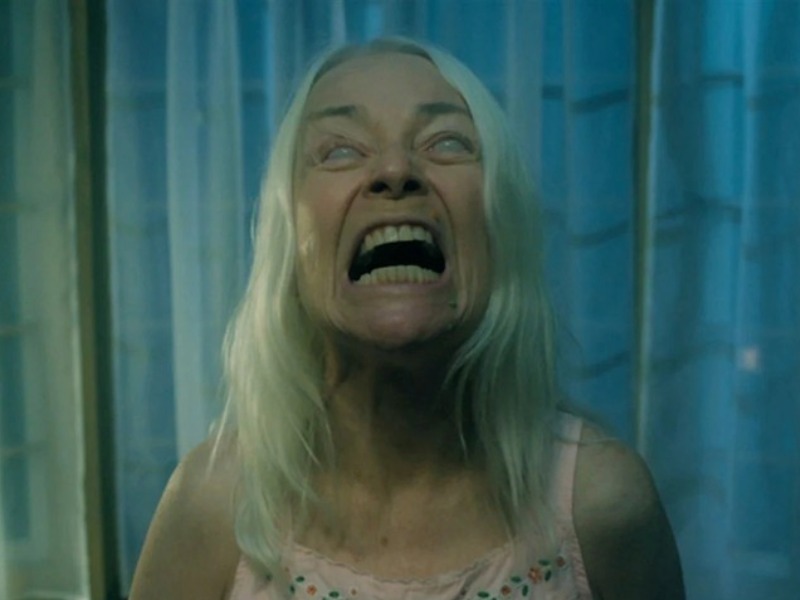
Horror loves a trapped-in-a-house premise. Add a one-take gimmick and a possession story, and a movie risks becoming a technical exercise with a monster bolted on. Bury the Devil is partly that, but it’s also a tense, atmospheric, and often unsettling little film. It doesn’t always know what to do with the dread it builds, though.
The Premise
The film follows Julia (Emmanuelle Lussier Martinez), a hospice nurse whose latest job takes her to the remote homestead of dementia patient Evelyn (Dawn Ford). The movie plays out in real time, with long unbroken shots, and a cold open shows the huge, remote house, which we know will end up in flames. The cast also includes Jason Cavalier, and the script is credited to Brad Hodson, Philip Kalin-Hajdu, and Adam O’Brien.
That’s a strong hook for a thriller. Knowing the ending before the story begins turns every quiet moment into a countdown, so the question isn’t whether it ends in fire but how everyone gets there.
What Works
The real-time structure builds dread. The one-take approach is more than a gimmick. Because the camera never cuts away, you can’t relax. You follow Julia from room to room, and every doorway, hallway, and dark corner could hold something. Horror depends on anticipation, and this approach turns that into the movie’s main engine. One critic noted you never know what’s waiting around the corner. I felt the same way.
The central pairing is the heart of the film. Julia and Evelyn work as a character study first and a horror story second. Dawn Ford has the harder job, and she makes Evelyn unpredictable: frail one moment, menacing the next. The film also leans on the way the character won’t remember who Julia is, and is ready to fight back, which gives their scenes together an uneasy push and pull. Lussier Martinez gives Julia a tired, professional warmth that makes her a believable caregiver and a believable target.
Dementia and possession make a disturbing pairing. One reviewer observed that the film links demonic possession with the symptoms of dementia. It’s a smart overlap, because both involve a person who seems to be someone else. When Evelyn says something strange, is it the illness or something worse? The film keeps you guessing, and the ambiguity is where it’s most effective and most uncomfortable.
The atmosphere is excellent. The house, a thunderstorm gathering outside, and the dim lighting make a convincing pressure cooker. A viewer on Rotten Tomatoes praised the atmosphere and lighting, and I’d second that. This is a film that looks better and more menacing in a dark room, so see it that way if you can.
What Doesn’t
The mythology is thin. This is the film’s biggest weakness. One review summed up the experience as atmospheric chills with uneven mythology. Another critic found a demon story with too many unanswered questions. I don’t mind ambiguity, and the film is stronger when it leaves things vague. But there’s a difference between mystery and missing information, and sometimes the script blurs the two.
The slow build tests patience. The first stretch is deliberate, and not everyone will stay with it. One critic described the film as a slow-build drama that’s very dry, with the one-take hook not quite sharp enough to pierce all the way through. I wouldn’t call it dry, but I understand the complaint. If you need scares early, the opening may test you.
It doesn’t add much to a crowded subgenre. A fair criticism is that the film, while a success as a technical challenge, doesn’t add much to the possession subgenre apart from a mean-spirited twist. Possession movies are everywhere, and this one stands out more for its method than its ideas. I enjoyed the execution, but I can see why someone might call it familiar once the technique stops being novel.
The One-Take Question
The one-shot format has become a recurring tool in modern cinema, and critics have noted its similarity to a war film like 1917. In horror, it works differently. There’s no cutaway to relieve the tension, and no edit to hide where the scare is coming from. That comes with a trade-off: when it works, it’s immersive, and when it doesn’t, you notice the seams. Bury the Devil mostly works, and the sustained takes give the scares weight a conventional cut wouldn’t.
Critical Reception
Reactions have been mixed but leaning positive. The film had its world premiere at FrightFest Glasgow on March 6. Early reactions were warm, and one festival review praised how different in tone and style it is from director Adam O’Brien’s earlier film Mom, calling him a director of multitudes. Another review gave it four stars and suggested that a prequel and sequel with this level of innovation could make the whole saga a high point of the possession subgenre.
Not everyone agrees. Critics at the lower end called it bog-standard despite its attempt at interesting camerawork. Audience reactions are just as divided: one Rotten Tomatoes user loved the film and urged viewers to make the effort to see it, while another called it boring. That split is typical for slow-burn horror, and it tells you who will enjoy it. If you like patient, atmosphere-first films, you’re in good shape. If you want fast scares and a clear explanation, you might not be.
Final Thoughts
Bury the Devil isn’t a revolution, but it’s a confident, well-built chiller with a strong central performance and a formal idea it commits to. It’s short, tense, and unnerving, and the dementia-meets-demon angle gives it a layer of real human fear. Its weaknesses are a hazy mythology and a story that doesn’t always justify its technique, but its strengths are strong enough that I’d happily recommend it.
It’s in select theaters and On Demand from August 21, 2026, so the best version is in a dark theater with the sound up. If that isn’t an option, turn off the lights and keep your phone out of reach.
Verdict: A tense, claustrophobic possession chiller that’s stronger in method than mythology.
Recommended if you liked: Relic, The Taking of Deborah Logan, Hereditary, Rope
Skip if: You want a fast pace, big scares, or a neatly explained demon.
RATING: 4/5