Some movies dare you to keep watching. Honey Bunch dares you to keep up — and then, once you do, rewards you with one of the most genuinely unsettling and unexpectedly moving horror films in recent memory.
There’s a particular kind of dread that doesn’t come from jump scares or monsters lurking in the dark. It comes from something quieter: the slow, creeping suspicion that the person who loves you most might also be the person doing you the most harm. That is the territory Honey Bunch stakes out, and it maps it with style, intelligence, and a gleefully unhinged willingness to go somewhere you absolutely do not expect.
The film is the sophomore feature from Canadian writing-directing duo Madeleine Sims-Fewer and Dusty Mancinelli, who announced themselves to the world with their bruising, unforgettable debut Violation in 2020. Where that film was raw, stripped down, and harrowing almost beyond endurance, Honey Bunch is its ornate, maximalist, and deeply strange opposite — a baroque fever dream dressed in golden 70s haze that premiered at the Berlin International Film Festival before landing on Shudder just in time for Valentine’s Day 2026. The timing feels deliberate and wickedly appropriate.
The Setup
Diana (Grace Glowicki) wakes from a coma with no clear memory of how she got there. Her husband Homer (Ben Petrie) is at her bedside — attentive, tender, almost suffocatingly loving — and gently steers her toward an experimental treatment at a remote facility run by the enigmatic Dr. Tréphine (Patricia Tulasne). The clinic promises to restore Diana’s damaged memories and help her hip heal. It’s tucked deep in the wilderness, at a gothic manor slowly being reclaimed by the surrounding woods. Strange things linger in its hallways. Other patients drift through the rooms. Nobody explains quite enough.
From the first frame, the directors signal that something is wrong. Not loudly — there are no blaring musical cues, no obvious monster — but in the subtle wrongness of Homer’s behavior. He comes across as the platonic ideal of a devoted husband, but the ideal sits just slightly off. He pokes at Diana’s anxieties, meets her doubts with a strident, paper-thin gentility. He snaps a knife open immediately after saying, “I know I’ve been acting strange lately.” His words and actions don’t quite match up, and Petrie plays this with remarkable restraint, all soft register and nuanced menace.
“There’s a blurry line between caring for someone and controlling them. Honey Bunch traces that line obsessively — and then gleefully erases it.”
Atmosphere as Weapon
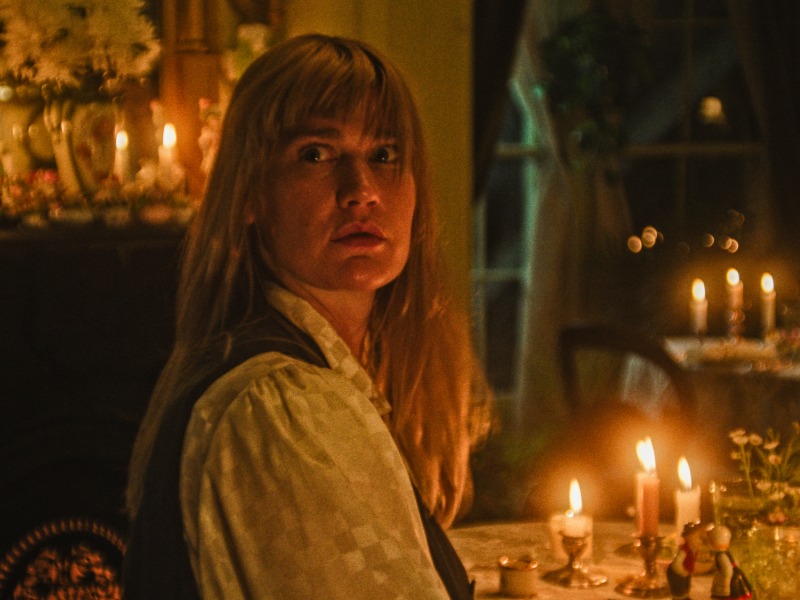
For its first hour, Honey Bunch moves at a deliberate, almost hypnotic crawl. The camera takes long, slow pans through sunlit corridors; rooms are bathed in golden gossamer light that makes everything look simultaneously beautiful and faintly nauseating. The score by Andrea Boccodoro makes prominent use of ghostly vocalizations — haunting, wordless voices that surface at key moments and refuse to let you settle. The film was shot in Ontario but carefully obscures any sense of time or place; the cars suggest the 1970s, the accents blend multiple countries, and the production design sits somewhere between a luxury spa and a surgical ward.
The atmosphere is the film’s greatest achievement in its opening act. Directors Sims-Fewer and Mancinelli build unease without needing to articulate it, piling up small wrong details — a disembodied POV shot gazing down at the couple from an upstairs window, Diana’s increasingly strange visions of distorted figures in the estate’s corridors, Homer’s habit of steering every conversation back toward what Diana can’t remember — until the accumulated weight of strangeness becomes genuinely oppressive. You don’t know exactly what kind of horror movie you’re watching. That uncertainty is the point.
A Genre Unto Itself
Honey Bunch wears its influences openly and with something like affection. The Stepford Wives gets name-dropped in the dialogue; Diana and Homer literally quote Alfred Hitchcock’s Rebecca to each other; the narrative debt to Gore Verbinski’s A Cure for Wellness is apparent in both the isolated medical facility and the slow revelation of its secrets. At one point, the film feels like a Jordan Peele social thriller; at another, it tips into the absurdist dark comedy of Yorgos Lanthimos at his most deadpan; a beat later, something genuinely grotesque and body-horror adjacent lurches into frame — including an uncommonly grisly shot of a nurse performing skull surgery that arrives without warning and without apology.
What’s remarkable is that these tonal lurches feel intentional rather than accidental. Honey Bunch uses genre instability as a tool, keeping the audience perpetually off-balance, unsure whether to laugh or recoil, unsure whether Homer is a villain or a victim, unsure whether the clinic’s staff are complicit or oblivious. Five minutes of mounting surgical dread can give way to absurdist relationship humor and feel completely coherent within this film’s singular logic. It shouldn’t work as consistently as it does.
The Performances
Grace Glowicki anchors the film as Diana, and it’s a technically demanding performance that never announces its difficulty. She plays a woman rebuilding herself from fragments — physically compromised, emotionally unmoored, unable to fully trust her own memories or the man narrating them back to her. Glowicki finds the intelligence and the quiet resistance underneath Diana’s fragility without ever overplaying it. Her gradual awakening to the truth of her situation is handled with enormous subtlety.
Ben Petrie, as Homer, does something almost harder: he plays a character who may or may not be the monster of the piece, and he sustains that ambiguity for nearly two hours without tipping his hand prematurely. Homer’s love for Diana feels genuine and terrible in equal measure. When the film asks the question — how far would you go for someone you love? — Homer is the answer, and the answer is disturbing in ways the film earns slowly.
The supporting cast fills out around them beautifully. Jason Isaacs and India Brown play a father-daughter pair also undergoing treatment at the facility; their warmth provides a counterpoint to the central couple’s fraying dynamic, and their subplot carries its own emotional weight. Kate Dickie, reliably excellent, brings quiet compassion to the role of a facility worker trying earnestly to help her patients while remaining entangled in the clinic’s hidden agenda.
What the Film Is Really About
Strip back the body horror, the gothic atmosphere, and the genre shapeshifting, and Honey Bunch is a film about something that rarely gets examined this directly: the way long-term love can curdle into possession, the way care and control can become functionally indistinguishable, the way a person’s desire to fix someone they love can cross into something that harms them irreparably. It’s a horror film about the ethics of devotion.
Sims-Fewer and Mancinelli invoke Mary Shelley’s Frankenstein in the film’s second half — the idea of creation driven by love turning into something monstrous, the moral vacuum opened up by technological capability outrunning ethical restraint. Unlike many films that share its premise, Honey Bunch grants Homer genuine love rather than simple villainy, and that makes his actions considerably more disturbing than if he were just a predator. He believes, in some broken and catastrophic way, that what he’s doing is right. The horror of that belief is the film’s engine.
“Unlike many of its obvious influences, Honey Bunch is built on a foundation of genuine love — and in some ways, that makes it all the more horrifying.”
Where It Stumbles
The film is not without its problems, and honest criticism requires naming them. The first hour, for all its atmospheric skill, does push patience to its limit. There are stretches where the pacing tips from deliberate into simply slow, and several scenes designed to build tension instead feel like wheels spinning in place. A film this confident in its atmosphere sometimes forgets that tension still requires narrative propulsion underneath it.
More frustratingly, the middle section has a habit of stating its themes too explicitly. Diana, Homer, and supporting characters occasionally deliver direct verbal recaps of the film’s ideas — the ethical stakes of memory manipulation, the nature of consent in a relationship — at points where the film has already made these things clear through action and image. It’s a scripting habit that undercuts the intelligence of the material; this is a film smart enough not to need to explain itself, and it would benefit from trusting that.
These are real limitations. They’re also limitations that the final act largely redeems, pulling together the film’s various threads — stylistic, thematic, and emotional — into a conclusion that is cohesive, genuinely affecting, and haunting in the way that only the best horror manages: not through shock but through recognition.
The Verdict
Honey Bunch is the exact kind of film that gets better the more you think about it after watching, the kind where small details from the first act suddenly acquire new and troubling significance once you understand what you were actually looking at. It is, as one critic aptly put it, a film that rewards close attention and multiple viewings — even if the second viewing, stripped of its mysteries, reveals the seams more clearly.
It is also exactly the kind of bold, genuinely weird, thematically ambitious genre filmmaking that needs an audience. In an era of IP sequels and algorithmically optimized horror, Sims-Fewer and Mancinelli have made something that could not have been made by a committee: a film with a specific, stubborn, uncompromising vision of what it wants to say and a fascinatingly strange set of tools for saying it.
Patience is required. It is thoroughly, absolutely worth it.
Honey Bunch is a slow-burn, genre-defying horror that asks serious questions about love, devotion, and the ethics of memory — then wraps those questions in golden 70s atmosphere, body horror, absurdist dark comedy, and one of the most quietly unnerving central performances of the year. Not perfect. Utterly memorable.