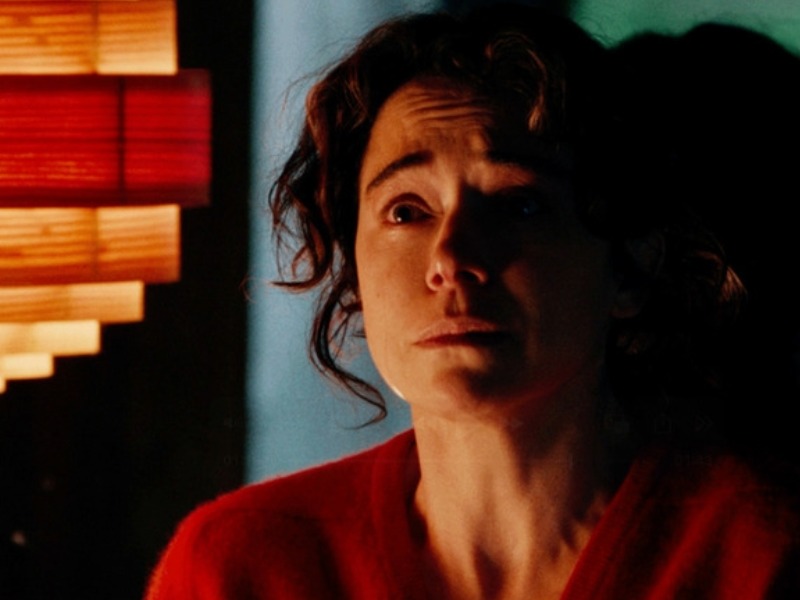
There is something deeply seductive about Osgood Perkins’ Keeper — and something deeply maddening about it too. Released in 2025, the film marks the director’s third feature in under two years, a breakneck pace that suggests either boundless creative energy or a filmmaker running slightly ahead of his own ideas. With Keeper, it sometimes feels like both at once.
The premise, on the surface, is deceptively familiar. Liz (Tatiana Maslany), a free-spirited artist, heads to a remote woodland cabin with her boyfriend of one year, Malcolm (Rossif Sutherland), a quietly imposing doctor. What should be a romantic anniversary weekend quickly slides into something far more sinister. Strange spirits stalk the fog-wrapped trees. Visions bleed into reality. And when Malcolm departs on a work errand, Liz is left alone with whatever has been awakened inside the house.
An Atmosphere Like No Other
Let’s start with what Keeper gets spectacularly right: the house itself. Production designer Danny Vermette gives the cabin a lived-in elegance — floor-to-ceiling windows, plush furnishings, an almost aggressively tasteful interior that seems to breathe. Cinematographer Jeremy Cox frames every room with uncanny intimacy. Shots hug doorframes, crouch beneath staircases, and press close to the characters in a way that makes the space feel simultaneously vast and suffocating.
The house is never fully mapped. You can’t quite determine where one room ends and another begins, how many floors there are, or what lies at the end of each corridor. This spatial ambiguity is one of the film’s greatest achievements, evoking the uneasy sense that something ancient and unseen is slowly closing in. Paired with a carefully curated needle-drop soundtrack — Peggy Lee, Mickey & Sylvia, Elvin Bishop — the film’s first act is as gorgeous and unsettling as anything Perkins has made.
Maslany Carries the Weight
None of it would work without Tatiana Maslany at the center. Fans of Orphan Black already know she is one of the most technically gifted performers working today, and Keeper gives her an altogether different kind of challenge: a woman slowly unraveling in isolation, whose grip on reality loosens in almost imperceptible increments. Maslany threads the needle between the mundane and the surreal with extraordinary precision, making Liz’s descent feel both intimate and genuinely frightening.
Rossif Sutherland is a revelation alongside her. Malcolm’s hypnotic vocal delivery — somewhere between a lullaby and a threat — gives Sutherland the kind of magnetic screen presence that makes every scene he occupies feel charged with unexploded tension. Together, the two generate a peculiar, off-kilter chemistry that suits the film’s dream-logic perfectly.
Where the Cabin Leaks
And yet. For all its visual confidence, Keeper is haunted by a script that struggles to sustain its own mythology. The film introduces Liz’s supernatural ordeal through a brilliant inciting incident — a piece of welcome cake, consumed despite her loathing of chocolate, that tips her into a waking nightmare reminiscent of Alice tumbling through the rabbit hole. It’s an inspired conceit. What follows is less so.
The film settles into a liturgical rhythm: Liz performs a menial task, hears a sound, investigates, finds nothing, then dreams of something terrible. This cycle repeats — and repeats — for the bulk of the runtime. Perkins seems to be deliberately testing audience endurance, but the tactic yields diminishing returns. Without meaningful escalation or character revelation, the effect is less “dread” and more “restlessness.”
The third act arrives with a jolt of genuine energy. Perkins finally throws open the doors he’s been teasing, and what spills out is nightmarish, wildly imaginative, and visually unlike anything else in recent horror. The makeup and creature work are genuinely unsettling — think Hellraiser by way of a fever dream — and Maslany absolutely commits to the chaos. For fifteen extraordinary minutes, Keeper becomes the film it promised to be.
But then comes the ending, and with it a cascade of unanswered questions that feel less like artful ambiguity and more like abandoned scaffolding. Who baked the cake? What exactly were these spirits? What happened to the other women from the film’s haunting opening montage? The themes of warped masculinity, manipulation, and control are legible — even a little too legible — but the connective tissue between image and meaning keeps slipping out of reach.
The Verdict
Keeper is a film of two unmistakable halves: one of 2025’s most atmospheric horror experiences, and one of its more frustrating narrative dead ends. As a showcase for its cinematographer, its production team, and above all its lead actress, it is frequently astonishing. As a coherent story with something to say, it too often mistakes mood for meaning.
Osgood Perkins remains one of the most genuinely distinctive voices in contemporary horror — and that distinctiveness is both Keeper‘s greatest strength and its fatal flaw. He conjures dread like few others working today. What he hasn’t yet mastered is knowing when to let the audience in.
Worth seeing, especially for Maslany’s committed, fearless performance and Jeremy Cox’s immaculate camerawork. Just don’t expect the film to explain itself when the lights come back on.
Rating: 3/5