The Great Flood arrives on Netflix promising apocalyptic spectacle and delivering something considerably stranger — a film that starts as a breathless high-rise survival thriller, then pivots, without warning, into a philosophical meditation on artificial consciousness and the strange mathematics of maternal love. It is two movies stitched together at the waterline, and whether that seam holds depends entirely on your appetite for ambiguity.
THE FIRST HALF: DISASTER DONE RIGHT
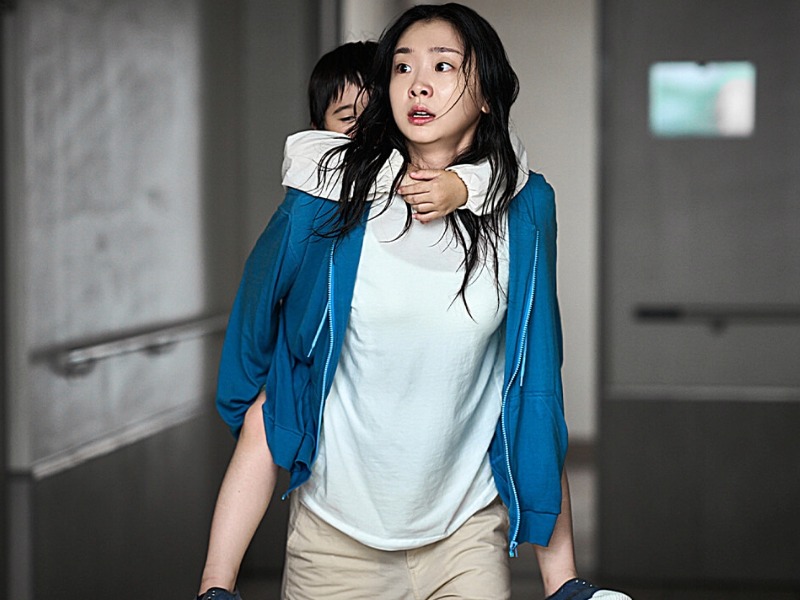
Director Kim Byung-woo opens with an image of staggering scale: floodwater swallowing an entire city, apartment towers receding into the grey surge like ship masts at sea. From the moment An-na (Kim Da-mi) grabs her six-year-old son Ja-in and bolts for higher ground, the film operates as a masterclass in contained disaster filmmaking. The thirty-floor apartment building becomes its own terrifying ecosystem — flooded lobbies, panic-stricken neighbours, cascading staircases, and the relentless hydraulic logic of water always seeking the lowest point.
Kim Da-mi is a revelation in these scenes. Soaked, breathless, and increasingly desperate, she communicates myriad layers of emotion — grief, calculation, animal instinct — with economy and physical precision. Park Hae-soo, playing the UN-affiliated agent Hee-jo who materialises as An-na’s unlikely protector, brings grounded authority to a role that could easily have been a generic action prop.
The set pieces are extraordinary. An underwater sequence in a submerged lift lobby and a rooftop confrontation played out against the chaos of a third incoming tsunami are among the most technically accomplished disaster filmmaking of 2025. The production design team earns every penny of what is clearly a generous Netflix budget.
The film’s first hour is the Korean disaster movie Korea has been building toward — technically audacious, emotionally immediate, and terrifyingly wet.
THE SECOND HALF: WHERE THE CURRENTS COLLIDE
[MILD SPOILERS FOLLOW]
Then the movie breaks open. A SWAT team intercepts An-na on the rooftop and the film’s true nature is revealed: Ja-in is not a biological child but an AI construct — the product of An-na’s own research, designed to develop synthetic emotional cognition by modelling a real mother’s love. An-na herself, we gradually understand, is also an AI simulation: a loop run thousands of times, sending her through the same collapsing building over and over until the simulation records a mother capable of genuine irrational sacrifice.
It is, on paper, a genuinely daring premise. Korean cinema has a proud tradition of genre-bending films that use genre mechanics as cover for larger philosophical inquiries. What separates consciousness from simulation? Can love be iterated into existence? If an AI learns to grieve, is that grief real?
The problem is execution. Kim and co-writer Han Ji-su’s screenplay introduces so many competing frameworks — flashbacks, flash-forwards, parallel timelines, digital memory fragments, orbital space stations — that the film’s emotional core begins to dissolve precisely when it needs to crystallise. A subplot involving a trapped girl in an elevator, Ji-soo, promises emotional counterweight but remains underdeveloped, a gesture toward a more patient film that this one didn’t have the runtime to become.
Ja-in, we are told, has been watching his mother fail and die for a thousand simulated lifetimes. It’s a heartbreaking idea. The film earns it in theory. In execution, it’s buried under another tidal wave.
WHAT THE FILM GETS RIGHT
Despite its narrative frustrations, The Great Flood refuses to be a small film. Kim Byung-woo — whose 2013 thriller The Terror Live announced him as a director of real precision — never loses control of the visual plane even when the story slips his grasp. The film is alive to its own imagery: digital paintings Ja-in sends across collapsing timelines, each one a miniature record of roads not taken; the recurring motif of water as both destroyer and medium of transmission; An-na’s expression in the final frames, a compound of exhaustion and something that might — just barely — be peace.
Lee Jun-o’s score is occasionally overemphatic (the piano motifs accompanying the mother-and-son reunion scenes lean into sentimentality rather than complicating it), but the sound design throughout is exceptional — water, metal, pressure and silence deployed with surgical care.
THE VERDICT
The Great Flood is the kind of film that earns its frustrations. It reaches for something genuinely ambitious — a disaster movie as a ghost story about artificial motherhood — and gets close enough that its shortcomings sting more than they would in a lesser film. It spent seven weeks in Netflix’s global Top 10 non-English films for a reason: there is nothing else quite like it on the platform, and its more audacious sequences lodge in the memory long after the credits roll.
Go in expecting the disaster movie the title promises, and you will likely feel cheated. Go in willing to be disoriented, willing to sit with ideas that the film introduces but doesn’t fully resolve, and there is something here worth experiencing — particularly Kim Da-mi’s performance, which is worth the watch on its own terms.
For patient sci-fi fans with a tolerance for beautiful incoherence: recommended. For everyone else: approach with the same caution you would any flood warning.
Rating: 4/5