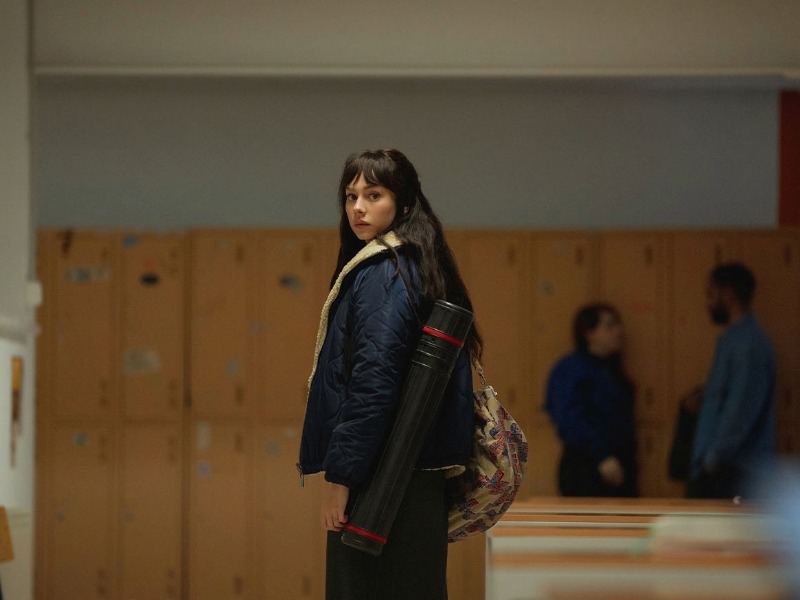
The Wailing marks the feature debut of director Pedro Martín-Calero, and it’s an ambitious one. The film interlaces three timelines across two continents, following three women who are stalked, decades apart, by the same unseen entity. It’s atmospheric, slow-building horror with a clear feminist backbone, and it wears its influences — It Follows, The Ring, the fiction of Argentine writer Mariana Enríquez — openly on its sleeve.
The Story
The film opens in a Madrid nightclub, all pulsing strobe lights and half-glimpsed shapes, before settling into its present-day thread: Andrea, a university student searching for her biological family, watches her boyfriend murdered in a shocking act of violence. In the aftermath, she starts to sense something invisible following her — something no one else believes is real.
The story then jumps back twenty years and across the Atlantic to La Plata, Argentina. There, college student Camila becomes fixated on a mysterious French woman named Marie, following and secretly filming her for a student project. That obsession pulls Camila into the same horror that will later consume Andrea. An unsettling touch: the apartment building where it all began in Madrid has an exact double in Argentina, both humming with the same doleful wail.
The connective thread across all three women is that the entity reveals itself only through recording devices — a camcorder in the ’90s thread, a livestream in the present day — which gives the film a found-footage nervousness even when it isn’t formally a found-footage movie.
What Works
The direction and cinematography are the film’s strongest assets. Martín-Calero, who came up as a cinematographer and music-video director (including work for The Weeknd), has a clear visual command — the nightclub opening alone signals a filmmaker with a real eye. The three leads are also frequently singled out as a highlight, with each actress bringing something different to her section of the story.
Thematically, the film is doing more than just delivering scares. Peña and Martín-Calero have described the project as a veiled allegory for male violence against women, and for how trauma and disbelief get passed down through generations of women in a family. It’s a weighty ambition for a genre film, and one that places The Wailing alongside other recent horror efforts by directors like Julia Ducournau, Rose Glass, and Jennifer Reeder that use genre conventions to unpack feminist ideas.
The film also earned real festival credibility — it premiered at the 72nd San Sebastián International Film Festival, where Martín-Calero won the Silver Shell for Best Director, and it picked up a Goya nomination for Best New Director.
What Doesn’t Work
The film’s reach occasionally exceeds its grasp. Several critics have pointed out that the screenplay is clearer on mood than on mechanics: exposition around the entity’s origins and motivations stays thin, and the protagonist at the center of it all is left without much concrete backstory. That vagueness works in the film’s favor for a while, keeping things eerie and mysterious, but by the final act — which leans harder into familiar haunted-house beats and jump scares — the ambiguity starts to feel more like a shortcoming than a stylistic choice.
There’s also a sense, echoed across multiple reviews, that the film is assembled from recognizable parts. The influence of It Follows in particular is hard to miss, and while the interlocking, multi-generational structure gives The Wailing more ambition than its central “invisible stalker” premise might suggest, it doesn’t always fully escape the shadow of its influences.
The Verdict
The Wailing is a confident, good-looking debut that’s more interested in mood and metaphor than in tidy answers. It won’t satisfy horror fans looking for a clean, fully-explained mythology, and the last stretch dips into more conventional territory. But as a slow-burn, feminist-inflected ghost story with strong performances and real visual craft, it’s a promising calling card for its director — and for Spanish-language horror more broadly.
Recommended if you liked: It Follows, The Ring, Talk to Me Skip if: you need your supernatural horror to come with a clearly explained rulebook