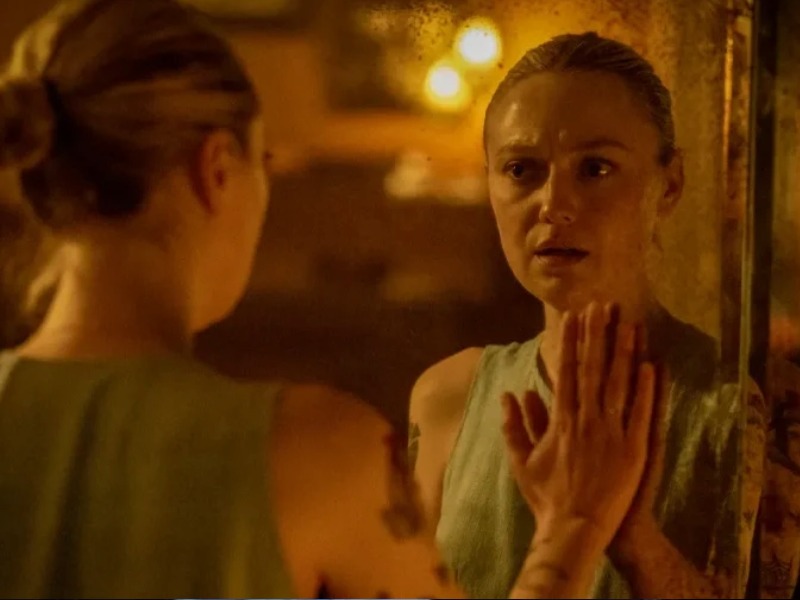
Bryan Bertino, the mind behind The Strangers, has made a career out of answering the door when you absolutely shouldn’t. His latest film Vicious continues that tradition—an elderly woman with missing fingers shows up at your door with a mysterious wooden box, and naturally, you invite disaster into your home.
The result is a beautifully shot, atmospherically rich horror film that asks profound questions about self-worth, sacrifice, and the fear of death… then refuses to answer any of them. It’s a movie that trades narrative coherence for ambiguity, mistakes vagueness for depth, and ultimately leaves you wondering not “what did I just watch?” but “what was the point?”
With a 44% critics rating and 34% audience score on Rotten Tomatoes, Vicious has emerged as one of 2025’s most divisive horror releases. Some see it as a tightly crafted psychological descent elevated by Dakota Fanning’s committed performance. Others see it as a pretentious, empty exercise in “elevated horror” that’s really just boring horror with good cinematography.
Having watched it, I land somewhere in the frustrated middle. Vicious has all the ingredients of a great horror film—a talented director, a committed lead actress, gorgeous visuals, genuine atmosphere—but it’s built on a foundation of thematic mud that collapses under the slightest examination.
The Setup: A Box, An Hourglass, and Impossible Choices
Polly (Dakota Fanning) is a directionless 32-year-old stuck in a dead-end job, living alone in a rental house owned by her sister. She’s flaky, depressed, and drowning in self-loathing—we know this because the film opens with her playing four voicemails: an annoyed boss, a worried mother, a frustrated pottery instructor, and a disappointed sister.
One evening, as Polly prepares for an important interview, an unnamed elderly woman (Kathryn Hunter) arrives at her door. The woman is missing two fingers from one hand and carries a small wooden box and an hourglass. She tells Polly plainly: “You’re going to die tonight.”
Before Polly can process this bizarre statement, the woman leaves the box and disappears. Naturally, Polly throws it away. Unnaturally, it keeps reappearing.
Then the phone calls begin. A voice impersonating her dead father. Another pretending to be her mother. Others she doesn’t recognize. They all give her the same instructions: place three things in the box—something she needs, something she hates, and something she loves. If she doesn’t comply by the time the hourglass runs out, she dies.
But here’s the catch: she can’t just put anything in the box. When she tries to place her cigarettes (something she claims to hate), the box reveals the lie—she doesn’t really hate them. The box knows the truth about what she truly needs, hates, and loves, even when she doesn’t.
What follows is 100 minutes of Polly being tormented by malevolent forces, experiencing visions, enduring self-harm, and making increasingly horrific sacrifices to survive the night. The question is whether any of it is real, what it all means, and why we should care.
What Works: Atmosphere, Fanning, and Bertino’s Visual Craft
Dakota Fanning Carries the Entire Film
Vicious is essentially a one-woman show, and Dakota Fanning shoulders that burden with impressive commitment. She’s in nearly every frame, often alone, reacting to invisible threats and descending into psychological breakdown.
Fanning delivers a standout performance, selling both the quiet desperation of Polly’s mundane life and the escalating terror of her nightmarish ordeal. When she’s experiencing extreme fear, pain, and death, Fanning makes you believe every moment, even when the script doesn’t give her much to work with beyond looking pained and smoking cigarettes.
The problem isn’t her performance—it’s that Polly is deliberately written as an underwhelming, frustrating character. Watching Vicious can feel like being a front-row hostage for a one-woman stage show, where that one woman is an underwhelming personality we still have to spend another hour and a half with.
Gorgeous Cinematography and Sound Design
If there’s one thing Bertino excels at, it’s creating atmosphere. The cold cinematography and meticulous sound design create a subtle claustrophobia reminiscent of works like The Babadook or The Others.
It looks fantastic, cinematography is stellar, and the haunting ambience is immensely effective. The house, despite being in a crowded street, feels isolated and desolate. There’s an almost gothic-horror quality to the production design, with a retro vibe thanks to the shot choices and set furnishings.
Every dimly lit corridor, every distant sound, every inverted mirror shot feels deliberately crafted to unsettle. When the film strips itself of explanations and dives into pure instinctive fear, there are genuinely unsettling moments that linger.
The sound design deserves special mention—the way voices distort on the phone, the creaking of the house, the relentless ticking of that hourglass. It all contributes to a sense of dread that keeps you on edge, even when nothing is explicitly happening on screen.
Kathryn Hunter’s Chilling Presence
Though she’s only on screen briefly, Kathryn Hunter’s brief appearance leaves a lasting chill, her performance as the mysterious old woman lingering long after she exits the frame.
Hunter has mastered the art of being deeply unsettling without doing much of anything. Her delivery of “You’re going to die tonight” is matter-of-fact and all the more disturbing for it. She’s not threatening or performatively scary—she’s simply stating a fact, which makes it worse.
The Premise Has Potential
The core concept—being forced to identify what you truly need, hate, and love under threat of death—is fascinating. It’s a philosophical horror premise that could explore identity, self-deception, and the things we refuse to acknowledge about ourselves.
What’s really interesting about it is the stuff it compels you to think about—which of your body parts you’d be most willing to lop off, for instance, but also deeper questions, like what aspects of your life you truly value and whether a fear of death is rational or a crutch holding you back from living your best life.
When the film leans into these questions, it’s at its best. Unfortunately, those moments are buried under repetitive jump scares and deliberate ambiguity.
What Doesn’t Work: Everything Else
The Script Is Vague to the Point of Meaninglessness
Perhaps the biggest problem with Vicious is how much Bertino’s screenplay leaves unanswered and unresolved.
Who was the old woman? Where did the box come from? What are the rules of this supernatural punishment? Why is Polly being targeted? Is any of this actually happening, or is it all in her head? What does the ending mean?
The film’s answer to all of these questions is: ¯_(ツ)_/¯
Now, ambiguity in horror can be powerful. The Babadook left viewers debating whether the monster was real or metaphorical. Hereditary blurred the line between mental illness and supernatural evil. But those films provided enough information to have meaningful interpretations.
Vicious provides so little context or internal logic that interpretation becomes impossible. In fact, he punctuates his ending with a hint at the magic box’s continued torture that made me think I never knew what this movie was about in the first place. I’m not sure Bertino does either.
One frustrated viewer summed it up perfectly: “I’m not sure there was even a plot. An old woman shows up with a mysterious box that refuses to go away unless Fanning does some bloody horrendous stuff to stop it. But is some or all of the movie just in her head? Who knows?”
It’s Exhaustingly Repetitive
For a 100-minute film, Vicious feels much longer. This is a movie that is all atmosphere and absolutely no substance. Scares become repetitive, the movie is ruthlessly predictable, and there just isn’t enough happening to keep you engaged in the plot.
The structure becomes formulaic very quickly:
- Phone rings with distorted voice
- Voice gives cryptic instruction or threat
- Polly cries/screams/looks terrified
- Something disturbing happens
- Jump scare with loud noise
- Repeat
By the third iteration, you know exactly what to expect. The film mistakes repetition for escalation, and what should build tension instead creates tedium.
The “Trauma as Horror” Trope Feels Tired
Vicious leans hard into the now-exhausted “emotional trauma as horror” trope. What once felt innovative in films like The Babadook—where the audience was left unsure if the threat was psychological or supernatural—has become a predictable formula. The film follows familiar beats: a fragile protagonist, symbolic menace, blurred reality, and anxiety masquerading as terror, without offering a fresh perspective.
We get it: Polly is depressed and self-loathing. The film opens with that information and hammers it repeatedly for the entire runtime. The wilted plants, the dirty dishes, the cigarette habit, the self-harm imagery, the voices telling her she’s worthless—it’s all very on-the-nose.
Trauma is used as a narrative shortcut instead of being explored with depth, and ambiguity functions more as a safety net than a bold creative choice.
If the film is meant to be a metaphor for suicidal ideation or depression (which seems likely), it doesn’t earn that reading through meaningful exploration. It just gestures vaguely at mental health themes while reveling in graphic self-harm imagery.
The Jump Scares Undermine the Atmosphere
For a director known for patient, atmospheric horror, Bertino relies way too heavily on loud noise jump scares. Despite a strong premise, Bertino struggles to define what he’s trying to say with the piece, falling back on way too many loud noises and jump scares.
There’s a time and place for jump scares, but when you use them every five minutes, they stop being scary and start being annoying. The film builds beautiful, slow-burn tension through cinematography and sound design, then ruins it with LOUD SUDDEN NOISES that feel cheap and manipulative.
It Could Have Been a Short Film
An outstanding example of “This could have been a half-hour horror anthology episode,” Vicious erases potential resonance with inessential stuffing that’s overlong, unnecessarily ambiguous, or just plain boring.
This is the fatal flaw. The premise is compelling enough for 20-30 minutes. Stretched to 100 minutes, it becomes diluted, repetitive, and ultimately tedious. There simply isn’t enough story, character development, or thematic depth to justify the runtime.
Imagine this as a segment in V/H/S or a Twilight Zone episode. The concept would shine. As a feature film, it collapses under its own weight.
The Ending Adds Insult to Injury
Without spoiling specifics, the ending of Vicious manages to be both confusing and predictable. After the credits rolled I felt like the film was building up to something different, like the last 5 minutes were disconnected from everything else.
The film hints that the box will continue its torture, suggesting either a sequel setup or just a nihilistic “nothing matters” conclusion. Either way, it feels less like a satisfying resolution and more like Bertino shrugging and saying “figure it out yourself.”
The Divided Reception: Art or Pretension?
The 44% critics score versus 34% audience score tells the story: critics appreciate Bertino’s craft even when the story fails, while general audiences just want to be entertained or scared—and Vicious doesn’t deliver either consistently.
The Positive Camp
Reviewers who enjoyed it praised:
- Dakota Fanning’s committed, emotional performance
- Gorgeous cinematography and production design
- Effective atmosphere and sound design
- Thought-provoking premise about identity and sacrifice
- Bertino’s skill as a visual filmmaker
Ready Steady Cut called it tightly crafted with a wonderful sense of escalating tension reminiscent of a raw suspense exercise.
The Negative Camp
Viewers who hated it cited:
- Boring, repetitive structure with no payoff
- Deliberately vague to the point of meaninglessness
- Jump scares that undermine atmospheric horror
- Thin characterization and frustrating protagonist
- Way too long for such a simple concept
- Exhausting “trauma as horror” clichés
Culture Crypt was particularly harsh: Unless someone has the same phobia about how responding to an unsolicited knock invites danger, or has an odd fascination with watching Dakota Fanning pinch her eyebrows together, I don’t know what target audience would find Vicious substantially scary, much less mesmerizing as supernatural suspense.
One Letterboxd user summed up the audience frustration perfectly: “Someone tell Dakota Fanning to fire her agent IMMEDIATELY. You cannot be doing these fuckass hot mess movies while your sister is booked and busy with hunger games 💀”
The Christmas Element Nobody Asked For
Oh, and apparently this is set during Christmas with festive decorations and music throughout. One reviewer joked: “If I had to listen to loud ass Christmas music for 90 minutes I’d probably cut off my toe to make it stop too”.
The Christmas setting adds nothing to the story except an odd tonal dissonance. Is it meant to contrast holiday cheer with horror? To comment on seasonal depression? It’s never clear, so it just feels like a random aesthetic choice.
Comparisons to Other “Elevated Horror”
Vicious desperately wants to be mentioned alongside films like The Babadook, Hereditary, or The Witch—psychological horror films that use supernatural elements to explore trauma, grief, and mental illness.
The difference is that those films have:
- Clear internal logic (even if the ending is ambiguous)
- Fully developed characters with understandable motivations
- Themes explored with depth rather than gestured at
- Scares that feel earned rather than manufactured
Vicious has the aesthetic of elevated horror without the substance. It’s elevated in cinematography only—the story, themes, and scares are all firmly B-tier.
Competently made but uninspired, Vicious exemplifies a genre stuck in repetition. Emotional horror isn’t inherently flawed, but without new ideas or risks, it becomes hollow. Familiarity, not fear, is the film’s lasting impression.
Who Should Watch Vicious?
Watch Vicious if you:
- Are a completist for Bryan Bertino’s work
- Love atmospheric horror even without narrative payoff
- Appreciate Dakota Fanning and want to see her carry a one-woman show
- Don’t mind deliberately vague endings open to interpretation
- Value cinematography and production design over storytelling
- Enjoy slow-burn horror with minimal action
- Want a Christmas-set horror film (apparently)
Skip it if you:
- Need your horror to make narrative sense
- Get frustrated by unanswered questions and ambiguous endings
- Prefer fast-paced horror with consistent scares
- Can’t stand repetitive jump scares
- Are sensitive to graphic self-harm imagery
- Want memorable characters you care about
- Value story over atmosphere
Content Warning: This film contains graphic violence including self-harm and amputation, images of a child dying, extreme fear and psychological distress, and themes of depression and suicidal ideation. It’s genuinely disturbing in ways beyond typical horror violence.
The Final Verdict: Beautiful Wrapping, Empty Box
Bryan Bertino is a talented visual filmmaker who understands how to create atmosphere, frame shots, and build dread. Bertino under-develops too many of his themes, reminding one that he’s a better director than a writer.
Vicious succeeds as a technical exercise in horror filmmaking. The cinematography is gorgeous. The sound design is effective. Dakota Fanning commits fully to a difficult role. These elements create moments of genuine unease and dread.
But a horror film needs more than atmosphere—it needs stakes, character investment, and some semblance of narrative purpose. This is a movie that might have worked as a short but feels woefully diluted as a 100+ minute feature length film.
The film asks profound questions about identity, sacrifice, and the fear of death, then refuses to engage with those questions beyond surface-level gestures. It mistakes vagueness for depth, repetition for escalation, and ambiguity for sophistication.
It’s so open to interpretation that it’s very likely everyone who sees it will have a slightly different take on it—but not because it’s meaningfully complex. It’s because Bertino hasn’t decided what his own film means, so he leaves it to viewers to do the heavy lifting.
There’s a great 30-minute horror short buried inside Vicious. Unfortunately, you have to sit through 100 minutes to find it, and by the end, you’re left wondering why you bothered.
If you’re a die-hard horror fan who values craft over content, Vicious offers enough technical merit to justify a watch. But for most viewers, this is a beautifully packaged mystery box that, when opened, contains nothing but questions and disappointment.
What works: Dakota Fanning’s committed performance, gorgeous cinematography, excellent sound design, effective atmosphere when it commits to slow-burn tension, Kathryn Hunter’s brief but chilling appearance
What doesn’t work: Deliberately vague to the point of meaninglessness, exhaustingly repetitive structure, relies too heavily on jump scares, weak characterization, should have been a short film, trauma used as narrative shortcut
Bottom line: A triumph of style over substance. Bertino proves he can still craft beautiful, atmospheric horror—he just forgot to include a story worth telling.
Rating: 4/5