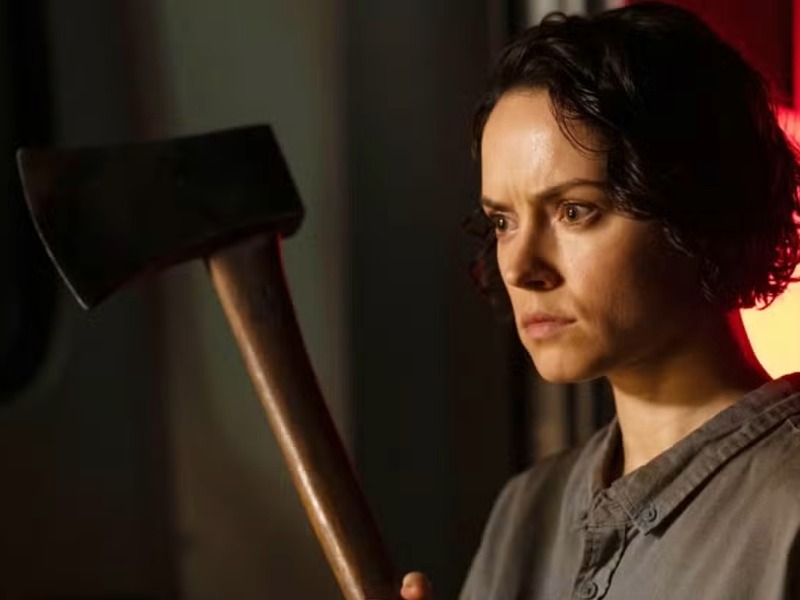
The zombie genre, long since stripped of its teeth by oversaturation, rarely surprises anymore. We Bury the Dead is a film that has no interest in playing by those rules. Director Zak Hilditch’s Australian horror-drama arrives wearing familiar clothing — the walking dead, a quarantine zone, desperate survivors — but underneath that genre skin beats something more grieving, more human, and ultimately more haunting than the marketing ever lets on.
Set against the scorched, ash-blanketed landscape of Tasmania following a catastrophic American military accident, the film follows Ava (Daisy Ridley), an American physiotherapist whose husband Mitch was on a business trip in the region when a rogue experimental weapon detonated off the coast, killing 500,000 people. The dead do not entirely stay dead. Some rise — slow, semi-sentient, teeth grinding — and the Australian military establishes a retrieval program to collect and bury the bodies before things deteriorate further. Ava volunteers, not out of duty, but grief. She needs to find Mitch. What she finds instead reshapes everything she thought she was searching for.
“It deals in effective chills rather than full-on undead action — a taut tale that asks what we’re really burying when we bury the dead.”
Performances
Daisy Ridley delivers the film’s beating heart. Stripped of the galactic mythology that defined her career’s first act, she is raw and entirely present here. Ava is not a hero — she’s a woman paralyzed by unresolved love and unresolved guilt, and Ridley communicates the weight of both through restraint rather than declaration. She does not monologue her grief; she carries it in her jaw, her silences, the way she approaches each new corpse as though it might be him.
Brenton Thwaites as Clay, the foul-mouthed biker-for-hire who becomes Ava’s reluctant partner, provides sharp tonal counterpoint. His performance skews toward loud Australian bravado, but Thwaites brings enough cracked vulnerability beneath the surface to make Clay genuinely affecting in the film’s later moments. The chemistry between Ridley and Thwaites carries the film through its quieter stretches with unexpected warmth.
Mark Coles Smith rounds out the key cast as a hardened soldier whose moral ambiguity injects real tension into the third act.
Cast:
- Daisy Ridley — Ava Newman
- Brenton Thwaites — Clay
- Mark Coles Smith — Soldier
- Matt Whelan — Mitch
Direction & Craft
Hilditch, best known for These Final Hours (2013) and his work adapting Stephen King’s Lisey’s Story, brings a filmmaker’s confidence in negative space. He resists the temptation to fill every frame with chaos, instead trusting the desolation of the Tasmanian landscape — shot largely in Albany, Western Australia — to do heavy lifting.
What works technically:
- Consistently striking cinematography: fog-choked valleys, abandoned homes, the unsettling geometry of bodies laid out in overgrown fields
- Practical zombie makeup and prosthetics that unnerve through wrongness rather than gore
- The signature teeth-grinding — a dry, rhythmic gnashing — is the film’s most effective horror device
- Score by British electronic musician Clark: throbbing, cold electronics that feel less like a movie score and more like the hum of damaged machinery
“The craft of the movie is top-notch, with compelling performances, urgent pacing, and gorgeous cinematography.” — IndieWire
Themes
The film’s central metaphor is not subtle, but it earns its emotional resonance through execution. Ava is not just looking for her husband — she is seeking the closure of a marriage that had begun to fracture before the bombs fell. Flashbacks reveal tensions, an affair, the kind of ordinary marital grief that predates the extraordinary catastrophe. The zombie apocalypse becomes a literalization of the thing Ava cannot bring herself to do: accept that what she is looking for is already gone.
The film’s most powerful scene involves a reanimated father methodically digging graves for his own family. There is no violence — only the spectral performance of duty. Ava helps him bury them. Then she helps him bury himself. The scene crystallizes the film’s thesis: sometimes the most profound act of love is letting something rest.
We Bury the Dead is less interested in survival than in acceptance. The walking dead are less a threat to be destroyed than a reminder — of what remains, of what cannot remain, and of the violence we do to ourselves by refusing to let go.
Where It Falters
The film is not without its limitations:
- Misleading marketing — the official synopsis promises relentless zombie action; the actual film is quiet and contemplative. Audiences expecting 28 Days Later will be frustrated.
- Second act pacing — several scenes extend past their emotional payoff without adding new information.
- Underwritten supporting cast — outside of Clay, supporting characters are sketched too broadly to carry emotional weight when the film needs them to.
- Abrupt ending — thematically coherent, but arrives with a quietness that will frustrate viewers expecting a more cathartic resolution.
None of these weaknesses are fatal, but they do mean the film occasionally coasts on atmosphere rather than pushing into the harder territory its premise implies.
Australian Context
It would be a disservice to discuss We Bury the Dead without acknowledging its specifically Australian texture. The film is deeply aware of its geography — the isolation, the scorched light, the particular bleakness of a landscape that has always carried its own apocalyptic imagination. Hilditch is working in a tradition that includes These Final Hours, The Quiet Earth, and the brooding fatalism of early George Miller.
Tasmania is not incidental as a setting — it is a character: remote, severed, unknowable. The military cordon that keeps survivors from the southern zone maps onto something older in the Australian psyche — the forbidden interior, the territory that doesn’t come back from.
Final Verdict
We Bury the Dead is a zombie film that has the audacity to be sad. Anchored by Daisy Ridley’s most vulnerable screen performance and guided by Zak Hilditch’s assured, mournful direction, it is the kind of genre film that trusts its audience to sit with discomfort rather than reach for the nearest shotgun.
Best for: Fans of slow-burn horror, grief dramas, atmospheric filmmaking, Maggie (2015), These Final Hours (2013) Skip if: You want action-heavy zombie survival, fast pacing, or a satisfying conventional ending