⚠️ MAJOR SPOILERS AHEAD ⚠️
If you’ve just finished watching It Ends and found yourself sitting in confused silence, wondering what exactly you just witnessed—congratulations, you’re experiencing exactly what director Alexander Ullom intended. This isn’t a movie that hands you easy answers wrapped in a neat bow. Instead, it leaves you with the same questions the characters themselves are asking: What does it all mean? And more importantly, what do we do when there are no answers?
Let’s break down the ending of this existential Gen Z horror film, explore what happened to each character, and unpack what that never-ending road actually represents.
The Setup: Four Friends, One Last Drive
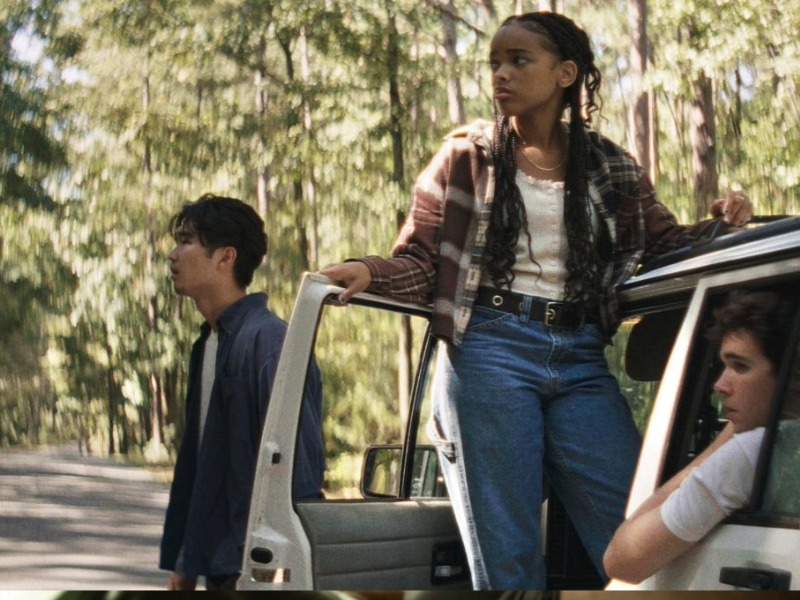
Four recent college graduates—James, Day, Fisher, and Tyler (who’s back from military training)—pile into Tyler’s Jeep Cherokee for what should be a simple late-night food run. It’s their last hangout before their paths diverge into adulthood. The conversation spans everything from whether fifty hawks could beat a man with a gun to James’s ambitious plans for a six-figure salary, a wife, and two kids.
But somewhere along the remote Florida panhandle road, something goes terribly wrong. They’re waiting for a turn that never comes, and the road simply never seems to end. When they try to backtrack, they discover a “Road Ends” sign, but beyond it lies only an impenetrable forest filled with desperate, panicking people who try to steal their car. There are no intersections, no buildings, no other traffic—just an infinite straight line stretching ahead and behind them.
Even stranger: their gas tank never empties, they never get hungry, and days turn into nights without any physical needs. They’re trapped in something that defies logic, and they can’t even remember where they were originally trying to go.
What Happens to Each Character?
As thousands of miles stretch on without any change, each member of the group responds differently to their predicament—and these responses become the emotional core of the film.
Tyler: The Realist Who Gives Up First
Tyler is the first to break. He’s the realist of the group who can see the pointlessness of continuing and decides to leave the car, heading into the forest and refusing to come back. Tyler represents those who, when faced with endless uncertainty and no clear destination, choose refusal over persistence.
His character had already shown signs of disconnection from normal life—he broke up with his girlfriend because she wanted to do something as simple as pick pumpkins together. He couldn’t commit to the small joys of a relationship, and when faced with an infinite road, he can’t commit to the journey either. Tyler chooses to opt out entirely rather than continue without purpose.
Day and Fisher: Surrendering Together
After Tyler leaves, the remaining three try to make it work, creating a cozy trailer-like atmosphere in the jeep, taking turns resting, playing music, and having hypothetical conversations. They even take “scream breaks” like smoke breaks—moments where they just let out the frustration and terror they’re feeling.
Eventually, Day decides she can’t do it anymore. Fisher, who had been the group’s lighthearted goofball, agrees with her. The two free-spirited friends, who never seemed to have concrete plans for after college anyway, choose to accept their fate and leave the journey. They represent those who, when faced with an endless road, choose to make peace with uncertainty rather than fight it.
James: The One Who Keeps Driving
This leaves James alone—the ambitious, Type-A personality who had the clearest vision for his future. James is the character who tried to turn every absurd hypothetical into a logic puzzle, who planned out his entire life trajectory, who believed in destinations and goals and concrete outcomes.
And here’s where the ending gets truly profound: James, in stark denial of what’s happening, offers to drive for all three of them. He refuses to give up. He refuses to accept that the road has no end. He keeps going.
The Final Moments: What Actually Happens?
The film’s conclusion is deliberately ambiguous, but here’s what we know:
By the time James circles back into the same conversation he once had with his friends, the loop ceases to feel like a curse, but instead feels inevitable as he finds comfort in the fragile intimacy of being understood, even briefly, as the drive continues.
The movie ends with James still driving. There’s a suggestion that he picks up a new passenger (played by director Alexander Ullom himself in a cameo), and the cycle may be beginning again. James keeps having conversations, keeps driving, keeps searching for meaning or an exit—but the road continues endlessly.
The somewhat comedic conclusion has layers of melancholy buried within it, and once you begin to excavate them, the emotional result is devastating.
So What Does the Road Actually Represent?
Director Alexander Ullom has intentionally left the interpretation open, but the film strongly suggests that the road is life itself—specifically, the terrifying transition into adulthood.
This road is a road we have all been on for all our adult lives. This road is life. Think about it: the characters are literally at the threshold between college and their adult futures. They’re about to split up, take jobs, move away, become “real” adults. And the film traps them at that exact moment of transition, forcing them to confront what that journey actually means.
Here’s the deeper reading:
The never-ending nature of the road represents how life doesn’t have a clear destination or endpoint that makes everything make sense. We’re all just driving forward, hoping we’ll reach something meaningful, but there’s no guarantee—and often, no clear “arrival.”
The lack of physical needs (no hunger, no need for gas) strips away all the practical concerns and forces the characters to confront existential questions. When survival is guaranteed, what do you do? What’s the point of continuing?
The desperate people in the forest represent everyone else who’s also trapped in this cycle of uncertainty—other people struggling with the same questions, some trying to escape by taking what others have.
The inability to turn back mirrors how you can’t return to childhood or college once you’ve left. There’s no going back to the comfort of before, only the uncertain road ahead.
The Three Responses: Three Ways of Coping with Life
Each character’s choice represents a different way people deal with the uncertainty of adult life:
Tyler chooses refusal — He opts out entirely. This represents people who, overwhelmed by the meaninglessness or difficulty of the path ahead, choose to step away from the conventional journey altogether. It’s neither good nor bad; it’s simply one response to an impossible situation.
Day and Fisher choose acceptance — They make peace with the uncertainty and decide that fighting against it causes more pain than accepting it. They represent people who learn to let go of control and find peace in not knowing where they’re going.
James chooses persistence — Despite everything, he keeps driving. He refuses to give up on the idea that there must be a destination, that the journey must lead somewhere. He represents people who cope with uncertainty by clinging to purpose, routine, and the belief that perseverance will eventually be rewarded.
The Genius (and Frustration) of the Ambiguous Ending
Director Alex Ullom knows what the road represents, but he’s not telling, which is for the best. There are so many allegories at play. One reviewer theorized it’s a paved River Styx—the mythological river of the dead. Others see it as a metaphor for late-stage capitalism, where we’re all trapped on a treadmill going nowhere. Some viewers read it as commentary on Gen Z nihilism and the hopelessness many young people feel about their futures.
And here’s the thing: all of these interpretations are valid. That’s the power of the film.
What’s most interesting about the film is how it can be unpacked in various ways. There’s no one way to interpret what the road and the characters’ decisions mean. Your interpretation will depend on your own anxieties, experiences, and relationship with uncertainty.
The Meta-Commentary: Are You James?
There’s a brilliant bit of meta-commentary happening in how audiences have responded to this film. Many viewers have expressed frustration that the movie doesn’t provide answers, doesn’t explain the rules of the road, doesn’t give them the satisfying resolution they were expecting.
One reviewer noted it’s hilarious that people complaining about the lack of payoff are literally in the same emotional headspace as James, hoping for some contrived realization that they’re in a simulation or that there’s a reason they deserve this—which the characters themselves discuss and dismiss in the film.
In other words, if you’re frustrated by the lack of answers, you’re experiencing exactly what James experiences. You’re demanding that the journey have meaning, that the road lead somewhere, that there be a logical explanation. The film is asking: Why do you need that? What if there is no satisfying answer? What then?
Is There Hope in This Ending?
Despite the bleakness of an infinite road, there’s actually a thread of hope woven through the conclusion:
Reaching the destination was important for James, but upon reaching there (or rather, never reaching it), he understands the value of the journey, of companionship, and finally, of living in the moment that one is in.
The film suggests that meaning isn’t found in reaching some predetermined destination—it’s found in the connections we make along the way, in the conversations we have, in the people who travel with us for however long they can.
One reviewer felt a surge of hope at the movie’s end, noting that perseverance pays off. Not in the sense that James “wins” or “escapes,” but in that he finds a way to keep going despite the absurdity. There’s something profoundly human in that refusal to give up, even when giving up would be the logical choice.
The Uncomfortable Truth
It Ends doesn’t comfort you with the idea that adult life has clear rules, achievable goals, or guaranteed meaning. Instead, it suggests something far more unsettling: Life, much like the road, offers no instruction manual, no guaranteed exits, and no assurance that endurance will be rewarded with meaning.
But it also suggests that this might be okay. That the journey itself—the people you meet, the conversations you have, the choice to keep going—might be all the meaning there is. And maybe that’s enough.
Why This Ending Works (Even If It Frustrates You)
The moment the film switches from a direct threat to existential dread actually feels like the most accurate representation of entering adulthood. When you’re young, you’re scared of tangible things—failing a test, not getting into college, losing friends. But as you get older, the fears become abstract: Am I on the right path? What if none of this matters? What if I’m just going through the motions forever?
It Ends captures that shift perfectly. It starts as a horror movie with real threats (the people in the woods, the impossible geometry of the road) but transitions into something more quietly terrifying—the realization that you might just keep driving forward forever without any clear reason why.
Final Thoughts: It Doesn’t End—And That’s the Point
The title It Ends is both literal and ironic. Yes, the movie ends. But the road doesn’t end for James. The questions don’t end. The uncertainty doesn’t end. And in real life, there’s no neat conclusion to the journey of adulthood either. We’re all on that road, trying to find meaning in the drive itself rather than in some mythical destination.
The film captures a universal fear—that anxiety-inducing transition into full-blown adulthood where we’re all expected to become responsible contributors to society. It’s a lot of pressure with no clear guide.
So if you finished this movie and felt unsettled, confused, or even frustrated—good. That means it worked. Because life doesn’t hand you a satisfying explanation at the end either. You just have to decide: Are you Tyler, walking away? Are you Day and Fisher, making peace with the uncertainty? Or are you James, stubbornly driving forward despite everything?
There’s no right answer. Just like there’s no right interpretation of the film. And maybe—just maybe—that’s exactly the point.
Quick Takeaways
What happens to the characters:
- Tyler leaves the car first, unable to cope with the endless meaninglessness
- Day and Fisher eventually surrender and leave together
- James continues driving alone, possibly picking up new passengers and starting the cycle again
What the road represents:
- The uncertain journey of adult life
- The transition from college/youth into full adulthood
- The search for meaning in a world without guaranteed destinations
- The endless pressure to keep moving forward without knowing why
The message:
- Life doesn’t promise clear answers or satisfying destinations
- Meaning might be found in the journey itself, not the arrival
- Everyone copes with uncertainty differently, and no choice is inherently right or wrong
- The real horror isn’t the supernatural—it’s the realization that we’re all on an endless road
It Ends is available for rental on Letterboxd Video Store through January 9, 2026. Buckle up.
Only James (from their group) reached the Road Ends sign, he turned around (did not go forward, but went back) and kept driving, picking up a passenger that he got to talk to him
Something I took from the hoardes in the woods was that they represent the people that you strive to stay ahead of in your early life and career. The urgency of ‘keeping ahead of the pack’ was immediate in the beginning. Then you reach a point in your life where you stop caring about who is in front or behind of you and learn to just carry on your own journey at your own pace. This is my interpretation of why the people stopped chasing them in the woods.
One must also realize the change in James. He actually is becoming more like Day and Fisher-playing the game of who survives, the man with the gun or 50 hawks. It is a playfullness he lacked earlier but now uses that same playfullness to build rapport with his new “buddy.” James is making the transistion with an added variable he missed before. In the end, James learns more than them all, how to keep driving and moving forward while finding respite in fellow travelers.