When Stephen Cognetti—the mastermind behind the legitimately terrifying Hell House LLC franchise—announced he was stepping away from found footage to make a traditional narrative horror film, expectations were high. After all, the original Hell House LLC is widely considered one of the scariest found footage films of the last decade, and his 2023 prequel The Carmichael Manor proved he still knew how to deliver cosmic dread.
Unfortunately, 825 Forest Road suggests that Cognetti’s greatest strength—creating atmosphere through handheld cameras and guerrilla-style tension—doesn’t necessarily translate to conventional filmmaking. What we get instead is a slow-burn haunted house movie with solid ideas, creepy moments, and genuine ambition that’s ultimately dragged down by repetitive structure, heavy-handed melodrama, and frustratingly slow pacing.
It’s not terrible. But for fans hoping Cognetti would bring his signature scares to a new format, it’s a disappointing missed opportunity.
The Setup: Small Town, Dark Secret
After a family tragedy—specifically the death of their mother in a car accident—Chuck Wilson (Joe Falcone) moves to the small town of Ashland Falls with his wife Maria (Elizabeth Vermilyea) and his college-aged sister Isabelle (Kathryn Miller). Chuck has taken a job at the local university, and they’ve purchased a suspiciously affordable house to make room for Isabelle, whose relationship with Chuck is strained by years of distance.
But Ashland Falls harbors a dark secret. For decades, the town has been terrorized by the ghost of Helen Foster, a woman who died by suicide back in the 1940s after her daughter was bullied to death. Helen’s attempts to stop the harassment—talking to parents, writing letters, seeking intervention from the school and town—were all ignored. When her daughter took her own life, Helen snapped, killing the bully’s family before taking her own life at their home.
Now Helen’s vengeful spirit haunts the town, driving residents to madness and suicide through nightmares and possession. The key to stopping her lies in finding her actual home at 825 Forest Road—but the address doesn’t match any existing street in town. And as Chuck soon discovers, his family may be living in the very house Helen is searching for.
The Chapter Structure: Innovative or Repetitive?
One of the film’s most divisive elements is its structure. 825 Forest Road is divided into chapters, each following a different family member’s perspective over the first few days in their new home. We see Chuck’s chapter, then Isabelle’s, then Maria’s, before everything converges in a final act.
On paper, this sounds innovative—a way to explore different viewpoints and slowly piece together the mystery. In practice, it becomes the film’s biggest weakness. Because many key events overlap across chapters, viewers end up watching the same scenes multiple times with only minor variations. It feels less like gaining new insight and more like padding the runtime.
One reviewer noted the frustration perfectly: many of the key moments overlap, and the viewer ends up unnecessarily exposed to the same events with little character development. When you’re watching the same jump scare or conversation for the third time, the tension evaporates.
The chapter structure also creates timeline confusion. When a scene is skipped because it doesn’t add new information, it’s not always clear where we are in the sequence of events. What could have been a tight 60-75 minute movie becomes a sluggish 101 minutes that tests patience.
The Atmosphere: When It Works, It Really Works
Here’s what Cognetti gets right: when 825 Forest Road commits to being creepy, it delivers. The film has a moody, atmospheric quality reminiscent of Silent Hill—all overcast skies, empty streets, and small-town secrets everyone knows but nobody discusses.
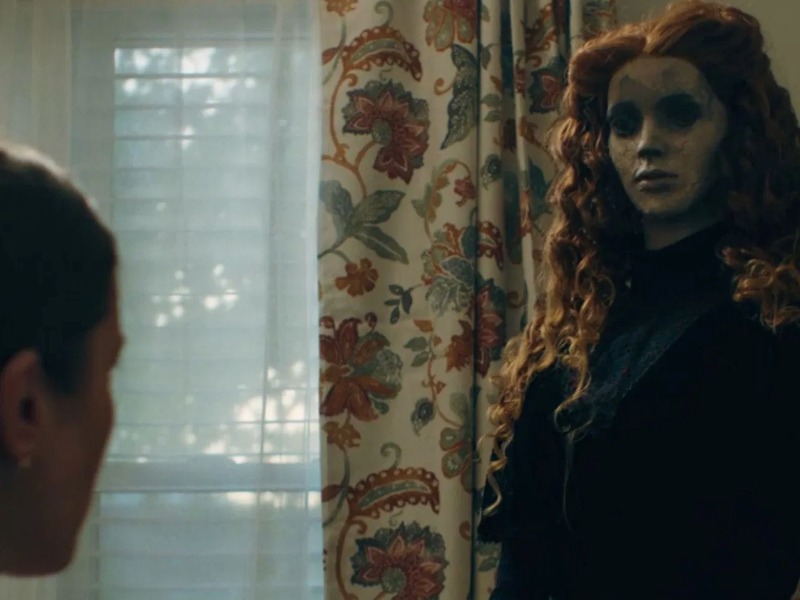
The ghost of Helen Foster is genuinely unsettling when she appears. Rather than relying on excessive CGI or gratuitous gore, Cognetti uses practical effects, makeup, and suggestive dread to create tension. There are fleeting figures appearing behind characters who don’t notice, hands reaching out from darkness, and that particular brand of creepiness that comes from knowing something terrible is about to happen.
The opening scene—a Zoom call between two girls that goes horrifyingly wrong—sets an effective tone. And there are scattered moments throughout where the film captures that same eerie energy: a character standing frozen in a doorway, sketches that eerily predict what’s about to happen, the slow realization that the town has been living with this curse for decades.
For fans of atmospheric, slow-burn horror that prioritizes dread over jump scares, there’s enough here to appreciate. The film evokes classics like Dead Silence and draws on the kind of local ghost stories that every small town seems to have—urban legends about the girl who died, the house nobody will enter, the address that doesn’t exist on any map.
The Problem: Too Much Talk, Not Enough Terror
Where 825 Forest Road stumbles hardest is in its balance between horror and drama. The film is so concerned with exploring themes of grief, trauma, mental health, and strained family relationships that it forgets to be scary for long stretches.
Multiple reviewers noted this issue—the movie focuses more on building backstory and explaining why things are happening rather than showing horror unfold on screen. We get lengthy conversations about therapy, guilt over the mother’s death, Chuck and Isabelle’s fractured relationship, and Maria trying to hold everything together. While these elements add context, they also create slow spots that feel more like a family drama than a horror film.
One critic put it bluntly: the film lacks any real terror because so little of it is focused on generating horror elements. There’s no tension building, no sense of dread accumulating. Characters talk about the ghost, research the ghost, discuss what to do about the ghost—but actual encounters are few and far between.
This is particularly frustrating because Cognetti proved with The Carmichael Manor that he knows how to build slow-burning dread. That film masterfully used its threadbare narrative to focus on terror. Here, it feels like Cognetti got so excited about telling a story with deeper themes that he forgot what genre he was working in.
The Melodrama Problem
Adding to the pacing issues is the heavy-handed melodrama. The film anchors itself in themes of trauma and suicide—both Helen’s backstory and the Wilson family’s grief—which gives the story emotional weight but also makes it oppressively grim.
There’s a content warning necessary here: this film heavily deals with suicide, self-harm, mental health struggles, and survivor’s guilt. These aren’t background elements—they’re central to both the ghost’s motivation and the family’s arc. For viewers sensitive to these topics, the film can feel emotionally exhausting.
The problem isn’t that these themes exist, but that Cognetti doesn’t trust his audience to understand them without explicit explanation. Characters spell out their feelings, trauma, and motivations in dialogue that feels more suited to a therapy session than a horror film. The subtlety that made Hell House LLC so effective is largely absent here.
The Performances: Solid Despite the Script
Despite the script’s shortcomings, the cast does admirable work. Elizabeth Vermilyea (who also appeared in Hell House LLC: Lineage) brings warmth and groundedness to Maria. Kathryn Miller effectively portrays Isabelle’s guilt and fear. Joe Falcone handles Chuck’s protective brother energy well, even when the character’s decisions don’t always make sense.
The supporting cast—including Hell House veteran Joe Bandelli and Brian Anthony Wilson—adds authenticity to the small-town setting. These feel like real people living in a cursed town, not just horror movie archetypes waiting to die.
Diomira Keane as Helen Foster makes the most of her limited screen time, creating a genuinely menacing presence. When Helen appears, the film snaps to attention. The practical effects and makeup used for her ghost are effective without being over-the-top.
The Ending: Abrupt and Unsatisfying
Without spoiling specifics, the ending of 825 Forest Road has drawn considerable criticism for being abrupt and under-explained. After spending so much time building up Helen’s backstory, the town’s secret, and the mystery of the address, the resolution feels rushed.
The film ends on a dark note—Helen attacks the siblings in their home, and the screen cuts to black. There’s no sense of closure, no understanding of what happens next, and no real resolution to the themes the film spent so long establishing. It’s the kind of ending that feels less like an artistic choice and more like the filmmakers ran out of budget or ideas.
One reviewer noted wishing the house had played a more prominent role in the third act. For a film titled after an address, the actual location feels underutilized in the climax. We spend so much time searching for 825 Forest Road that when we’re finally there, it doesn’t pay off.
The Divided Reception: Who Likes It and Who Doesn’t
Interestingly, 825 Forest Road has created a split in the horror community. Some viewers genuinely love it, calling it one of the best psychological horror films they’ve seen in years. Others found it boring, repetitive, and lacking in scares.
The pattern seems clear: viewers who enjoy slow-burn, atmosphere-heavy horror with minimal jump scares and heavy themes tend to appreciate what Cognetti is attempting. They value the moody cinematography, the small-town dread, the practical effects, and the attempt to create something more thoughtful than your average haunted house movie.
Viewers who come to horror for thrills, scares, and forward momentum tend to be disappointed. They find the pacing sluggish, the chapter structure repetitive, and the emotional drama overwhelming. As one reviewer noted, it’s the kind of film where you might find yourself checking your phone regularly, waiting for something to happen.
Comparing to Hell House LLC: A Step Backward?
For fans of Cognetti’s Hell House franchise, 825 Forest Road will likely feel like a downgrade. The original Hell House LLC worked because it understood the power of suggestion—the clown that moves when nobody’s looking, the figure standing in the shadows, the growing dread as the investigation team realizes something is terribly wrong.
That film also benefited from its found footage format, which created immediacy and intimacy. The handheld cameras made viewers feel like they were there, trapped in the haunted hotel with the characters. The format’s limitations forced Cognetti to be creative with his scares.
In 825 Forest Road, Cognetti has all the tools of traditional filmmaking—multiple cameras, professional lighting, polished cinematography—but the film feels less focused as a result. One reviewer noted there’s no atmosphere, and everything looks bland, like any other generic horror film assembly-lined for streaming services.
Breaking free from found footage should have been liberating. Instead, it exposed that Cognetti’s strengths may be specifically tied to that format’s constraints.
The Silver Linings
Despite its flaws, 825 Forest Road isn’t without merit:
The practical effects are solid. When horror does arrive, it looks good. The ghost makeup, the subtle movements in the background, the creeping sense of wrongness—these technical elements work.
The small-town atmosphere is well-realized. Ashland Falls feels like a real place with real history. The cinematography captures that rural American gothic vibe effectively.
The core story has potential. Helen Foster’s backstory about a mother driven to violence by her daughter’s bullying and the town’s indifference is genuinely tragic and could have been the foundation for something powerful.
It’s earnest in its ambitions. Cognetti clearly wanted to make something more than just another haunted house movie. He’s attempting to explore grief, trauma, and the cyclical nature of violence. The execution falters, but the intention deserves credit.
Who Should Watch This?
Watch 825 Forest Road if you:
- Are a completist for Stephen Cognetti’s work
- Enjoy slow-burn psychological horror over jump scares
- Appreciate indie horror that prioritizes mood over action
- Don’t mind repetitive structure if the atmosphere is strong
- Love small-town gothic horror with Silent Hill vibes
- Are interested in horror that tackles heavy themes like suicide and grief
- Want to support indie horror filmmakers trying new things
Skip it if you:
- Need consistent scares and forward momentum
- Get frustrated by slow pacing and repetitive scenes
- Prefer your horror without heavy melodrama
- Expect something as scary as the Hell House LLC films
- Want a satisfying, complete ending
- Are sensitive to suicide and self-harm content
The Verdict: Solid Craft, Lacking Terror
825 Forest Road occupies that middle tier of indie horror—technically competent, well-intentioned, but ultimately unable to deliver on its promise. It looks professional, features solid performances, and attempts to explore meaningful themes. But it forgets that horror movies need to be, well, horrifying.
The chapter structure that should have added depth instead creates repetition. The emotional drama that should have created investment instead slows the pace to a crawl. And the scares that should have been amplified by the traditional format instead feel diluted and infrequent.
Cognetti has proven he can create genuine terror within the confines of found footage. 825 Forest Road suggests that when given more freedom, he gets distracted by story elements that don’t serve the horror. It’s a film where you can see the ambition, respect the effort, and still walk away disappointed.
For Hell House fans, this might be worth watching just to see Cognetti try something different. But if you’re hoping for the same level of scares in a new package, you’ll likely come away underwhelmed. Sometimes constraints breed creativity, and perhaps Cognetti works best when working within limitations.
What works: Solid atmosphere, good practical effects, earnest ambition, decent performances, creepy premise
What fails: Repetitive chapter structure, sluggish pacing, lack of sustained scares, heavy melodrama, abrupt ending
Content Warning: This film contains extensive discussion and depiction of suicide, self-harm, mental health struggles, child bullying leading to death, and graphic violence. Viewer discretion strongly advised.
Rating: 4 out of 5