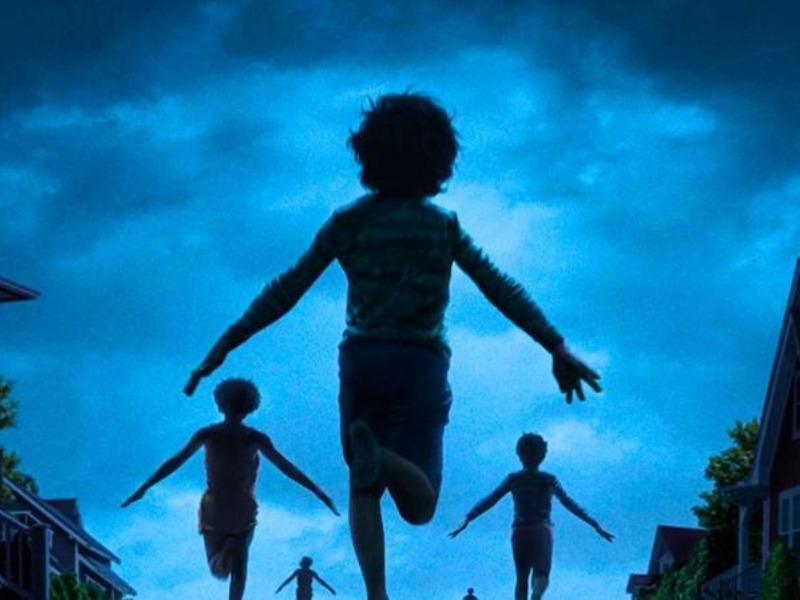
After the surprise breakout success of Barbarian in 2022, Zach Cregger had enormous expectations to meet with his sophomore feature. With Weapons, he doesn’t just meet them—he shatters them, delivering a wildly ambitious, darkly comic, and deeply unsettling horror epic that confirms him as one of the most exciting voices in modern genre filmmaking.
A Mystery That Defies Convention
In the small Pennsylvania town of Maybrook, seventeen children from the same third-grade classroom walk out of their homes at exactly 2:17 a.m. and disappear without a trace. No signs of struggle. No forced entry. Just empty beds and a community torn apart by questions nobody can answer. The only child who remains is Alex Lilly, whose silence offers no comfort to the terrified adults left behind.
What follows is not your typical missing children thriller. Drawing inspiration from films like Paul Thomas Anderson’s Magnolia and Denis Villeneuve’s Prisoners, Cregger constructs a non-linear narrative mosaic that follows multiple characters as they spiral through their own private hells, unaware that their stories are converging toward something far stranger and more horrifying than anyone could anticipate.
We meet Archer Graff (Josh Brolin), a construction contractor and father of one of the missing children, drowning in helpless rage. Justine Gandy (Julia Garner) is the children’s teacher, placed on leave under suspicion and spiraling into alcoholism. Paul Morgan (Alden Ehrenreich) is a police officer and Justine’s ex-boyfriend, caught between professional duty and personal feelings. James (Austin Abrams) is a homeless drug addict whose burglary attempt goes catastrophically wrong. Each character exists in their own chapter, their own perspective, their own nightmare—until the film’s structure begins folding in on itself and the pieces snap together with devastating clarity.
A Structure That Serves the Chaos
The film’s episodic structure has drawn comparisons to Magnolia, though critics note it’s more rigid in its approach. Each segment follows a similar pattern: we meet someone in crisis, watch them attempt to cope, see them search for answers, and then witness something deeply wrong unfold before the cycle resets with a new character. It sounds repetitive on paper, but Cregger uses this repetition masterfully, creating a rhythm that builds tension through familiarity while constantly shifting our understanding of what we’ve already seen.
The non-linear storytelling isn’t just a gimmick. It’s essential to the film’s exploration of grief, loneliness, and how trauma ripples through a community. By the time the stories converge in the film’s explosive final act, we understand these characters not as puzzle pieces to be solved, but as fully realized people whose pain has made them vulnerable to something ancient and malevolent.
Horror That Laughs at Itself
Like Barbarian before it, Weapons refuses to pick a lane between horror and dark comedy, instead existing in the uncomfortable space where screaming and laughter blur together. The film opens with George Harrison’s haunting song “Beware of Darkness” and ends with MGMT’s “Under the Porch,” bookending a story that oscillates wildly between moments of genuine terror and pitch-black humor.
Cregger’s command of tone is extraordinary. One moment, you’re white-knuckling your armrest during a genuinely frightening sequence; the next, you’re laughing nervously at the absurdity of human behavior under extreme stress. The film understands that horror and comedy share the same DNA—both rely on subverting expectations and pushing audiences to uncomfortable emotional extremes.
The supernatural element at the film’s core—which I won’t spoil—feels less like a traditional monster and more like a dark fairy tale come to life. Critics have compared it to a Stephen King take on the Pied Piper, and there’s truth to that. The reveal has proven divisive, with some finding it brilliant and others feeling it doesn’t quite justify the elaborate buildup, but even skeptics admit the journey is captivating.
Performances That Ground the Madness
The ensemble cast is uniformly excellent, committing fully to Cregger’s tonal tightrope walk. Julia Garner brings vulnerability and raw emotion to Justine, a woman watching her life collapse under the weight of suspicion and guilt. Josh Brolin delivers controlled intensity as a father consumed by helplessness. Alden Ehrenreich provides steady grounding as the conflicted police officer trying to hold everything together.
But the real revelation is Amy Madigan as Gladys, a character I can’t say much about without spoiling the film’s biggest surprises. Critics have singled her out for award-caliber work, and it’s easy to see why. She brings depth and humanity to a role that could have been a one-dimensional caricature in lesser hands, making scary, as one reviewer put it, weirdly wonderful.
Critical and Commercial Triumph
Weapons opened with a perfect 100% score on Rotten Tomatoes from early reviews, eventually settling at an impressive 96% critics score. Metacritic gave it an 81 out of 100, indicating universal acclaim. Audiences responded enthusiastically as well, with a 90% verified audience score and an A- CinemaScore—rare grades for a horror film this unconventional.
The film opened to $43.5 million domestically, topping the box office and giving Warner Bros. its sixth consecutive #1 opening with over $40 million. It showed impressive legs at the box office, dropping only 44% in its second weekend while grossing $268.3 million worldwide against a modest $38 million budget. In September 2025, industry reports indicated the film would generate at least $65 million in theatrical profit.
The film even cracked Letterboxd’s Top 50 Films of 2025 within days of release, sitting at Rank 19 and outranking major releases like How to Train Your Dragon and Predator: Killer of Killers.
The Divisive Elements
Not everyone is on board with Cregger’s vision. Some critics and audiences found the first hour too slow, the structure too rigid, and the payoff not quite worth the elaborate setup. The New York Times felt the segmentation came across as delay tactics. Some viewers were disappointed by what they perceived as a lack of genuine scares, expecting pure horror but getting something more cerebral and tonally complex.
The film’s runtime of 2 hours and 8 minutes tests patience for those expecting a lean genre exercise. Character development occasionally takes a backseat to structural experimentation, with some figures feeling like chess pieces moved into position rather than fully realized individuals. The ending has sparked debate, with some finding it perfectly calibrated and others feeling it either over-explains or under-delivers on the promise of the mystery.
A Personal Story Born from Grief
Cregger has revealed that Weapons was inspired by the death of his close friend and collaborator Trevor Moore from The Whitest Kids U’ Know. That grief permeates the film, which at its core explores how trauma makes us vulnerable, how pain can be weaponized, and how hurt people hurt people. The supernatural horror becomes a metaphor for the way suffering consumes and controls us, spreading through communities like an infection.
The film includes a subtle reference to a sketch Moore wrote, a quiet tribute embedded in a story fundamentally about loss and the desperate, sometimes destructive ways people try to cope with the unbearable.
The Verdict
Weapons is that rare beast: a sophomore film that’s more ambitious, more confident, and more accomplished than an already impressive debut. Cregger has crafted a horror epic that respects its audience’s intelligence, refuses easy answers, and trusts viewers to navigate its purposefully disorienting structure.
It’s not a perfect film. The pacing lags in spots, some tonal shifts don’t quite land, and the ending won’t satisfy everyone. But these are the kinds of flaws that come from swinging big, from trying to do something genuinely original in a genre crowded with safe, derivative entries.
This is a film about loneliness, grief, and the terrible things we’re capable of when we’re pushed to our breaking point. It’s a twisted bedtime story, a suburban nightmare, and a wickedly entertaining piece of genre filmmaking that confirms Zach Cregger as a horror auteur worth watching closely.
Whether you find it brilliant or frustrating, you won’t forget it. And in an era of instantly disposable entertainment, that counts for something.
The Bottom Line: Bold, unconventional, and deeply personal, Weapons is a genre-blending triumph that establishes Zach Cregger as one of horror’s most exciting voices. It’s not for everyone, but for those willing to embrace its dark fairy tale logic and tonal audacity, it’s one of 2025’s most rewarding cinematic experiences.
Rating: (5/5)